
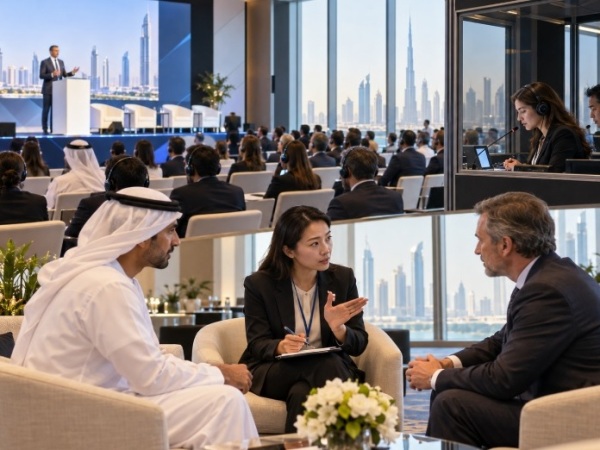
Dubai has become one of the world’s most international business hubs, bringing together executives, investors, government representatives, entrepreneurs, and professionals from different linguistic and cultural backgrounds.
International conferences, corporate events, exhibitions, and leadership meetings often involve participants who speak different languages, including English, Arabic, Chinese, Russian, and other global languages.
In these situations, professional interpretation is not simply about converting words from one language to another. It is about ensuring that ideas, messages, and business objectives are communicated accurately and naturally across cultures.
One of the most important decisions event organizers must make is choosing between simultaneous interpretation and consecutive interpretation.
Both formats have an important role, but they serve different purposes.
The right choice depends on factors such as:
- Event size
- Number of languages involved
- Type of audience
- Speaker format
- Time limitations
- Level of interaction required
Understanding the difference between these two interpretation methods helps organizers create smoother, more professional multilingual events.
Key Takeaways
| Interpretation Format | Best Used For |
| Simultaneous interpretation | Large conferences, international summits, live events, multilingual audiences |
| Consecutive interpretation | Business meetings, negotiations, interviews, smaller professional discussions |
| Professional interpreters | Ensure accuracy, cultural awareness, and smooth communication |
| Language preparation | Helps interpreters handle technical terms and industry-specific topics |
| Event planning | Interpretation requirements should be considered early in the organization process |
What Is Simultaneous Interpretation?
Simultaneous interpretation is a method where the interpreter listens to the speaker and delivers the interpretation almost at the same time.
The interpreter usually works from a soundproof booth using professional audio equipment. The audience listens through headphones and receives the translated message while the original speaker continues talking.
This format is commonly used for:
- International conferences
- Government events
- Large corporate meetings
- Trade exhibitions
- Diplomatic events
- Global forums
For example, during a Dubai business conference, a speaker may present in English while interpreters provide Arabic, Chinese, or Russian interpretation for international attendees.
The main advantage of simultaneous interpretation is efficiency.
The event continues naturally without long pauses between the original speech and the interpreted message.
Advantages of Simultaneous Interpretation
- Saves Time
Because interpretation happens in real time, conferences can follow the planned schedule.
This is especially important for:
- Multi-speaker events
- Full-day conferences
- International forums with strict agendas
- Creates a Professional Conference Experience
Professional simultaneous interpretation allows international participants to follow discussions immediately.
This improves:
- Audience engagement
- Speaker flow
- Event professionalism
- Supports Multiple Languages
Large Dubai events often include participants from different regions.
Simultaneous interpretation allows several language channels to operate at the same time, making it suitable for multilingual audiences.
What Is Consecutive Interpretation?
Consecutive interpretation works differently.
The speaker pauses after a sentence, paragraph, or section, and the interpreter delivers the message in the target language.
The interpreter listens carefully, takes notes when necessary, remembers key information, and then reproduces the message accurately.
This format is often used for:
- Business negotiations
- Executive meetings
- Training sessions
- Interviews
- Small conferences
- Site visits
For example, during a meeting between an Arabic-speaking company and Chinese business partners, a consecutive interpreter may help both sides communicate clearly while allowing more personal interaction.
Advantages of Consecutive Interpretation
- More Personal Communication
Because the conversation includes natural pauses, participants can build stronger connections.
This makes consecutive interpretation valuable for:
- Negotiations
- Partnership discussions
- Relationship-building meetings
- Allows Greater Detail
In some situations, speakers need to explain complex ideas carefully.
Consecutive interpretation gives the interpreter more time to understand and reproduce detailed information.
- Works Well for Smaller Settings
Not every event requires conference equipment.
For smaller professional environments, consecutive interpretation may provide a practical and effective solution.
Simultaneous vs. Consecutive Interpretation: Which One Does Your Event Need?
Choosing the correct interpretation format depends on your event objectives.
Choose Simultaneous Interpretation When:
Your event involves:
- Hundreds of participants
- Multiple languages
- International speakers
- A fixed schedule
- Presentations and keynote speeches
Examples:
- International business conferences
- Government forums
- Large exhibitions in Dubai
- Global leadership events
Simultaneous interpretation allows participants to receive information immediately without interrupting the event flow.
Choose Consecutive Interpretation When:
Your event involves:
- Smaller groups
- Direct conversations
- Negotiations
- Relationship-building
- Interactive discussions
Examples:
- Executive meetings
- Contract discussions
- Business visits
- Private consultations
Consecutive interpretation supports a more conversational environment.
The Importance of Professional Conference Interpreters
A common misunderstanding is that interpretation is simply knowing two languages.
Professional interpretation requires much more.
A skilled interpreter must understand:
- Language structure
- Cultural differences
- Industry terminology
- Professional communication styles
- Speaker intention
- Context and meaning
For example, a business presentation in English may contain financial, legal, or technical terminology.
A professional interpreter must communicate not only the words but also the intended meaning.
This is particularly important in Dubai’s international business environment, where communication often takes place across cultures.
Interpretation Across English, Arabic, Chinese, and Russian Business Environments
Dubai’s international business landscape creates demand for communication across many languages.
English Interpretation
English is commonly used in:
- International conferences
- Corporate presentations
- Investor meetings
- Multinational events
However, effective interpretation requires understanding professional tone, industry vocabulary, and presentation style.
Arabic Interpretation
Arabic communication often involves important cultural elements related to:
- Professional relationships
- Respect
- Business etiquette
- Context
Interpreters working between Arabic and other languages must understand both linguistic and cultural expectations.
Chinese Interpretation
Chinese business communication often requires attention to:
- Precision
- Professional relationships
- Negotiation style
- Long-term partnership perspectives
A skilled interpreter helps ensure that business messages are transferred accurately while respecting cultural communication patterns.
Russian Interpretation
Russian-speaking business environments may involve complex discussions related to:
- Investment
- Technology
- Energy
- International cooperation
Professional interpretation helps maintain clarity and confidence during important conversations.
How to Prepare for a Multilingual Conference
Successful interpretation begins before the event.
Organizers should provide interpreters with:
- Event agenda
- Speaker information
- Presentation materials
- Technical terminology
- Company names
- Industry-specific vocabulary
Preparation allows interpreters to become familiar with the subject matter and deliver more accurate communication.
For complex conferences, interpreters often work in teams and coordinate terminology before the event begins.
Common Mistakes Event Organizers Should Avoid
Choosing Based Only on Price
Interpretation quality directly affects the audience’s understanding of the event.
Selecting an interpreter only based on cost may create communication problems.
Providing Materials Too Late
Interpreters need time to prepare specialized vocabulary.
Late preparation can affect accuracy.
Assuming Any Bilingual Person Can Interpret
Speaking two languages does not automatically mean someone can interpret professionally.
Interpretation requires specialized skills, concentration, memory, and experience.
Ignoring Cultural Communication Differences
Successful international communication requires cultural awareness, not only translation.
Conference Interpretation Services in Dubai
As Dubai continues to attract international organizations and global events, professional multilingual communication has become an essential part of successful conferences.
Professional interpretation services can support:
- International conferences
- Corporate events
- Business negotiations
- Executive meetings
- Exhibitions
- Training programs
- Cross-cultural business communication
Experienced interpreters help organizations communicate effectively across languages while maintaining accuracy, professionalism, and cultural understanding.
Whether your event requires simultaneous interpretation for a large international audience or consecutive interpretation for executive discussions, selecting the right format is an important part of event planning.
Frequently Asked Questions
What is the difference between simultaneous and consecutive interpretation?
Simultaneous interpretation happens in real time while the speaker continues talking. Consecutive interpretation happens after the speaker pauses, allowing the interpreter to deliver the message afterward.
Which interpretation format is better for conferences in Dubai?
Large international conferences usually require simultaneous interpretation, while smaller meetings and negotiations often benefit from consecutive interpretation.
How many languages can be supported at an event?
The number depends on the event format, equipment, and interpreter availability. Large conferences can support multiple language channels.
Can one interpreter provide simultaneous interpretation for an entire event?
For long or complex events, simultaneous interpreters usually work in teams because the concentration required is extremely demanding.
Why is professional interpretation important?
Professional interpreters ensure that communication is accurate, culturally appropriate, and effective in high-stakes business environments.
Conclusion: Choosing the Right Interpretation Format for Your Event
The success of a multilingual conference depends not only on the speakers and content but also on how effectively the message reaches every participant.
Simultaneous interpretation provides speed and efficiency for large international events.
Consecutive interpretation creates space for detailed discussion and personal communication.
The right choice depends on your audience, objectives, and event structure.
For organizations hosting international conferences, meetings, and business events in Dubai, professional interpretation ensures that language differences do not become communication barriers.
With the right interpretation approach, every participant can fully engage, understand the message, and contribute confidently — regardless of the language they speak. :::The article ends at this point. No continuation is missing after the provided cutoff.
Author Information & Trust Section
Reviewed by Communication Specialist Team at Nooshin Panahi Voice & Connection. This guide reflects established principles in vocal mechanics, non-verbal communication, and professional interpersonal dynamics.