

Introduction
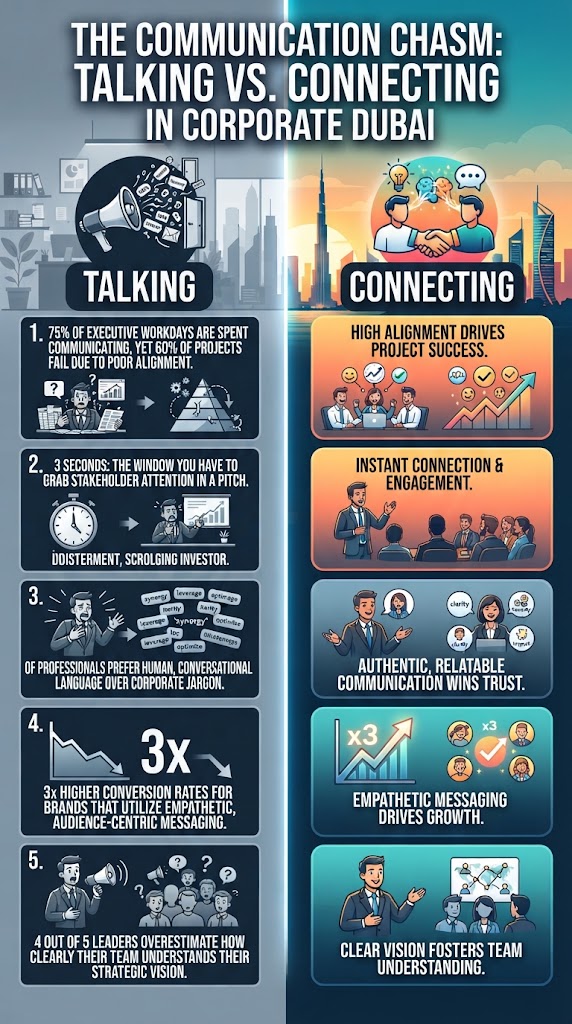
Walking out of a high-stakes presentation confident only to meet blank stares, delayed deliverables, or silence is a familiar executive frustration. Metrics were accurate, slides were polished, yet engagement evaporated. In fast-paced, high-performance hubs like Dubai—where multicultural teams, aggressive execution cycles, and fierce competition demand sharp precision—talking is frequently confused with communicating. Leaders often assume that distributing slides or speaking means communication occurred. In reality, a significant gap separates transmitting data from establishing an authentic connection that drives action.
Persistent team misalignment, unconvincing corporate messaging, or stalled proposals typically indicate a breakdown in message resonance rather than a flawed strategy. This guide breaks down why professional communication breaks down, examines seven unmistakable warning signs of disconnected messaging, and offers structured solutions to drive meaningful connection.
Key Takeaways at a Glance
| Feature | Description |
| Core Problem | Confusing information dissemination (talking) with emotional and cognitive resonance (connecting). |
| Regional Impact | Dubai’s multicultural business landscape demands cross-cultural clarity and empathetic communication. |
| The 7 Signs | Silence post-pitch, recurring basic questions, surface-level agreement, high deliverable churn, disengagement, defensiveness, and stagnant conversions. |
| The Solution | Transitioning from transactional broadcasting to strategic, audience-centric communication coaching. |
The Illusion of Communication: Why Talking Isn’t Connecting
Wilbur Schramm’s interactive communication model demonstrates that meaningful dialogue requires a shared field of experience. Relying exclusively on corporate jargon, dense data dumps, or one-way broadcasts creates cognitive interference. Research featured in Harvard Business Review reveals that while executives spend 75% to 80% of their workday communicating, poor communication remains the chief driver of failed projects, delayed targets, and internal friction. In cosmopolitan markets like Dubai, executive boards feature leaders from dozens of cultural and linguistic backgrounds, making the margin for misunderstanding razor-thin.
7 Signs Your Message Isn’t Landing
- Eerie Silence Following High-Stakes Pitches
A completely silent room following a strategic pitch is rarely a sign of awe. It typically reflects cognitive overload or disengagement. When listeners cannot synthesize complex narratives quickly, they freeze instead of engaging, lacking a clear anchor to formulate meaningful questions.
- Constant Follow-Up Requests for Basic Clarifications
Fielding elementary questions twenty-four hours after an alignment session indicates a compromised initial delivery. When communication lacks crisp direction, individuals fill voids with subjective assumptions, driving operational mistakes and lost time. Effective communicators anticipate ambiguities and build clarity directly into their core framework.
- Polite ‘Yes-Men’ Agreement Without Real Execution
In diverse corporate cultures, politeness frequently trumps direct candor. Colleagues and clients often nod and agree to prevent discomfort. True alignment is proven through execution, not courteous gestures. If vocal agreement never translates into operational progress, your message registered merely as ambient noise.
- High Project Churn and Misaligned Deliverables
When internal departments or external agencies miss brief requirements, executive intent was likely framed transactionally. Outlining technical parameters without communicating strategic intent and emotional stakes yields flat, misaligned execution.
- Audience Disengagement and Pervasive Multitasking
Stakeholders checking emails or phones during briefings indicate that your narrative lacks relevance, pacing, or a compelling hook. Audiences naturally stay attentive when narratives respect their time through structured, dynamic delivery.
- Defensive Reactions to Constructive Feedback
Constructive feedback met with resistance, crossed arms, or immediate excuses signals an ego threat. Critique delivered without psychological safety or relational context triggers instinctual defensiveness rather than a growth mindset.
- Stagnant Conversion Rates and Flat Commercial Metrics
When marketing propositions or enterprise pitches fail to convert, your core value proposition has missed the mark. Clients do not purchase abstract feature lists; they invest in solutions that mitigate their specific operational anxieties. Inward-focused messaging fails to generate commercial momentum.
Bridging the Gap: Transforming Communication into Connection
Shifting from transactional talking to high-impact connection requires a systematic refinement of your delivery architecture:
- Adopt an Audience-First Perspective: Anchor every message in what listeners must understand, feel, and execute, directly mapping arguments to their cultural dynamics and commercial priorities.
- Master Concise, High-Impact Language: Eliminate corporate buzzwords. Clear, sensory articulation overcomes cognitive fatigue and leaves a lasting impression on busy decision-makers.
- Integrate Active Feedback Checkpoints: Build purposeful pauses into presentations to encourage immediate critique, clarifying questions, and two-way debate.
Frequently Asked Questions
Why do corporate presentations routinely fail to engage?
Most rely on data-heavy monologues rather than dynamic problem-solution narratives, causing cognitive fatigue.
How can leaders bridge multicultural barriers in Dubai?
Prioritize simple phrasing, structured visuals, deliberate pacing, and verified feedback over passive head-nodding.
What separates transactional communication from transformational connection?
Transactional communication is a one-way transfer of data, whereas transformational connection builds trust, aligns values, and inspires proactive collaboration.
How can an executive uncover unvoiced team feedback?
Watch for passive compliance and late-stage project pivots. Establishing psychological safety and low-friction feedback channels helps reveal underlying concerns.
Conclusion
Communication is the core driver of executive leadership and commercial influence. Broadcasting metrics and technical lists is no longer sufficient in fast-paced corporate environments. By recognizing the seven signs of disconnected messaging and embracing an audience-centered approach, executives can transform ordinary briefings into catalysts for strategic alignment and measurable success.
Explore specialized Communication Coaching with Nooshin Panahi to master high-impact connection and executive influence.