

In a high-growth startup environment where seed capital converts to Series A within eighteen months, speed is treated as the primary competitive advantage. In Dubai’s fast-moving business ecosystem—where over 200 nationalities collaborate in shared hubs like DIFC, Hub71, and Dubai Internet City—organizational velocity rarely breaks down over technology or market fit. It breaks down over cross-cultural ambiguity and misaligned executive speech.
When rapid headcount expansion collides with disparate linguistic backgrounds, silent friction emerges. Misunderstandings between founders, functional leads, and distributed engineering squads create phantom work, missed sprints, executive churn, and stalled negotiations. To scale sustainably, founders must quantify this invisible operational leak and install deliberate multilingual leadership systems across their organizations.
Key Takeaways
| Core Insight | Practical Impact |
| English as a Lingua Franca Is Not Shared Comprehension | Fluent vocabulary masks deep differences in contextual communication (high-context vs. low-context intent), leading to incorrect product execution. |
| Silent Alignment Traps Burn Capital | When team members from hierarchical cultures do not challenge executive directives openly, delayed blockers inflate engineering and marketing burn rates. |
| Systematized Alignment Infrastructure Delivers ROI | Implementing standardized asynchronous memos, cultural mapping, and structured verification mechanisms protects sprint velocity and team retention. |
The Hidden Balance Sheet: What Miscommunication Actually Costs a Dubai Startup
The financial toll of fragmented team communication rarely appears as a line item. Instead, it manifests in missed delivery milestones, duplicated engineering hours, and premature executive departures.
Data across global workforce research indicates that small businesses with up to 100 employees lose hundreds of thousands of dollars annually directly to communication inefficiencies. For venture-backed startups scaling from 15 to 80 employees across Dubai, the cost surfaces in three distinct operational areas:
- Rework and Sprint Slippage: A European product lead issues specifications using understated feedback; a South Asian development team interprets the request literally without challenging edge cases. The resulting two-week sprint misses commercial requirements, delaying client onboarding.
- Executive Talent Churn: C-suite executives recruited from global markets often struggle to navigate the high-context, relationship-driven nuances of Middle Eastern board members or local commercial partners. The cost to replace a VP-level leader in the UAE typically ranges between 50% and 150% of their annual salary when accounting for headhunting fees, visa issuance, and lost momentum.
- Impaired Go-to-Market Negotiations: Pitching to regional family offices or government-linked enterprises requires balancing technical value propositions with culturally nuanced respect for hierarchy and protocol. Western directness often reads as impatience, while vague diplomacy from founders stalls pipeline velocity.
Why Multilingual Diversity Creates Latent Execution Gaps
Dubai’s startup landscape brings together native Arabic speakers, European expatriates, South Asian technical specialists, and East Asian operations leaders. While business is nominally conducted in English, each team member processes priorities through the filter of their native cultural communication model.
   [Low-Context / Explicit]                     [High-Context / Implicit]
Direct Feedback | Task-Oriented              Nuanced Feedback | Relationship-First
    (e.g., German, Dutch, US)                    (e.g., GCC Arabic, Japanese, Levant)
                |                                                    |
                +------------------- THE FRICTION GAP ---------------+
High-Context vs. Low-Context Clashes
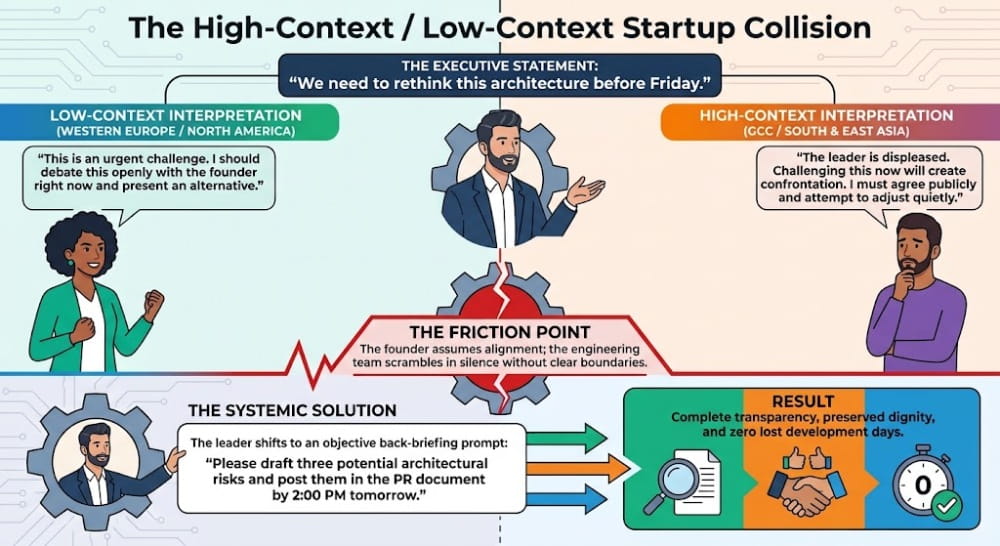
In low-context cultures (such as Germany, the Netherlands, or the United States), words carry the entire message; communication is expected to be direct, transparent, and explicit. In high-context cultures (common across the GCC, Levant, and parts of East Asia), communication relies heavily on background, tone, interpersonal relationships, and hierarchy.
When a direct founder tells an engineering team, “This feature is flawed and makes no sense,” the low-context founder believes they are offering objective, efficient critique. To team members from relationship-first backgrounds, the statement feels like a personal reprimand, shutting down transparent communication and psychological safety.
The “Nodding Agreement” Trap
In many cultures represented in UAE startups, questioning an executive in a public all-hands or sprint planning meeting is perceived as disrespectful. Team leads nod, smile, and say “yes”—not to confirm feasibility, but to acknowledge the founder’s authority. The problem remains hidden until the deployment fails, turning a small clarification into an expensive fire drill.
The 4-Pillar Alignment Framework for Multilingual Leadership
Startup leaders cannot rely on informal office banter to bridge these cultural chasms. High-growth teams require an operating system designed around structural clarity.
┌────────────────────────────────────────────────────────┐

│   MULTILINGUAL LEADERSHIP ALIGNMENT SYSTEM (MLAS)      │

└────────────────────────────────────────────────────────┘
                                │
┌───────────────────────┬───────┴────────┬──────────────────────┐
▼                       ▼                ▼                      ▼
[Pillar 1]              [Pillar 2]       [Pillar 3]             [Pillar 4]
Asynchronous First    Closed-Loop      Culturally Calibrated   Strategic
Documentation         Verification     Feedback Loops          Communication
(Amazon-Style Memos)  (Back-Briefing)  (3-Channel Protocols)   Coaching
Pillar 1: Asynchronous-First Documentation
Replace verbal directives and open-ended Slack brainstorms with structured asynchronous memos. When technical specifications, strategic pivots, and OKR definitions are published in clear, structured prose, non-native English speakers have time to digest nuances, run translation checks if necessary, and formulate precise questions without real-time pressure.
Pillar 2: Closed-Loop Verification (Back-Briefing)
Never ask, “Does everyone understand?” The default answer will always be “Yes.” Instead, institutionalize military-style back-briefing. Ask team leads:
- “Walk me through how your team will execute this over the next 72 hours.”
- “What trade-offs are you making to hit this deadline?”
- “Where do you see this requirement breaking our current workflow?”
Pillar 3: Culturally Calibrated Feedback Channels
Establish multi-tiered avenues for upward feedback. While low-context operators readily post critiques in public Slack channels, other team members require private 1-on-1 environments or anonymous asynchronous input forms to flag critical operational risks without social friction.
Pillar 4: Dedicated Executive Communication Coaching
A founder’s voice sets the operational tempo of the enterprise. Providing executive coaching in cross-cultural leadership and strategic communication equips founders to modulate their communication style—switching between decisive directness and consensus-building nuance based on their audience.
Operational Audit: The Startup Communication Health Checklist
Use this evaluation system during quarterly reviews to detect structural friction points before they impact capital efficiency:
- [ ] Documented Working Norms: Does every department have a one-page “How to Work With Me” document detailing communication preferences, response-time expectations, and meeting styles?
- [ ] Jargon & Idiom Elimination: Are company presentations free of regional idioms (e.g., sports metaphors like “touch base” or colloquial British/American idioms) that alienate non-native speakers?
- [ ] Multi-Format Briefings: Are company-wide announcements delivered in at least two formats (e.g., live town hall supported by a detailed written summary)?
- [ ] Safe-to-Challenge Protocols: Is there an established mechanism for junior engineers and specialists to veto unfeasible roadmaps without risking standing or relationship capital?
- [ ] Decoupled Strategic Meetings: Are high-stakes debates separated from final decision meetings by at least 24 hours to give all leaders equal processing time?
Frequently Asked Questions
Why is English proficiency alone insufficient for cross-cultural startup alignment?
English serves as a shared vocabulary, but it does not standardize communication context. Two professionals can possess professional English fluency while interpreting directness, hierarchy, and urgency in entirely contradictory ways. Without shared communication frameworks, vocabulary alone cannot prevent misunderstandings regarding priorities, deadlines, and constructive criticism.
How does leadership miscommunication affect venture capital fundraising in Dubai?
International and regional venture capitalists evaluate founder cohesiveness and operational discipline during due diligence. When an executive team displays subtle misalignment, hesitation, or conflicting interpretations of strategic roadmaps during partner meetings, it signals weak execution capacity and elevates the perceived risk profile of the venture.
What is the most effective way to address the “nodding agreement” habit in multicultural engineering teams?
Replace confirmation questions with demonstration prompts. Instead of asking if an engineer understands a sprint requirement, ask them to outline the testing parameters they intend to use or explain the technical dependencies of the task. This reframes the conversation from testing obedience to exploring technical execution.
How can founders evaluate whether cross-cultural friction is slowing down operations?
Look for operational symptoms: recurring feature rollbacks, missed delivery dates following seemingly unanimous meetings, low participation in public Q&A sessions, and exit interview feedback citing vague expectations. These patterns indicate structural communication breakdowns rather than individual performance issues.
When should a scaling startup hire a specialist in executive communication and leadership alignment?
Startups should engage specialist advisory during inflection points: specifically when scaling beyond 20 employees, raising Series A capital, or expanding cross-border operations into neighboring Gulf markets. Intervening at this stage prevents toxic organizational silos from solidifying.
Building Cohesion Across High-Growth Teams
Technical vision and access to capital are prerequisites for scaling in Dubai’s competitive market, but leadership alignment dictates whether a startup survives rapid expansion. When founders overlook cross-cultural nuances, the resulting miscommunication acts as a steady drain on velocity and runway. By replacing conversational ambiguity with structured documentation, closed-loop feedback systems, and calibrated executive communication, organizations convert multicultural diversity from an operational risk into a resilient strategic advantage.
Navigating executive alignment across multinational teams requires dedicated strategic support. For targeted executive coaching, leadership communication frameworks, and cross-cultural alignment tailored to founders and leadership teams across the Middle East, explore strategic advisory services at NooshinaPanahi.com.
This guide was prepared using verified organizational behavior principles, regional market insights, and current leadership communication standards to provide clear, actionable guidance for high-growth enterprise leaders.