

Boardrooms and international summits across Dubai, Riyadh, and Abu Dhabi demand more than technical competence; they require commanding presence. Women leaders in the Gulf Cooperation Council (GCC) increasingly spearhead regional economic transformations, state-backed entities, and multinational enterprises. Yet, navigating high-stakes public speaking environments often involves bridging deep-rooted cultural etiquette with the assertive delivery expected on international stages.
Achieving vocal authority requires systematic training rather than relying on natural charisma. This guide examines how senior female executives in the Gulf can project unshakeable vocal presence, eliminate unintentional speech habits, and align nonverbal authority with executive standing.
Key Takeaways
| Core Insight | Practical Impact |
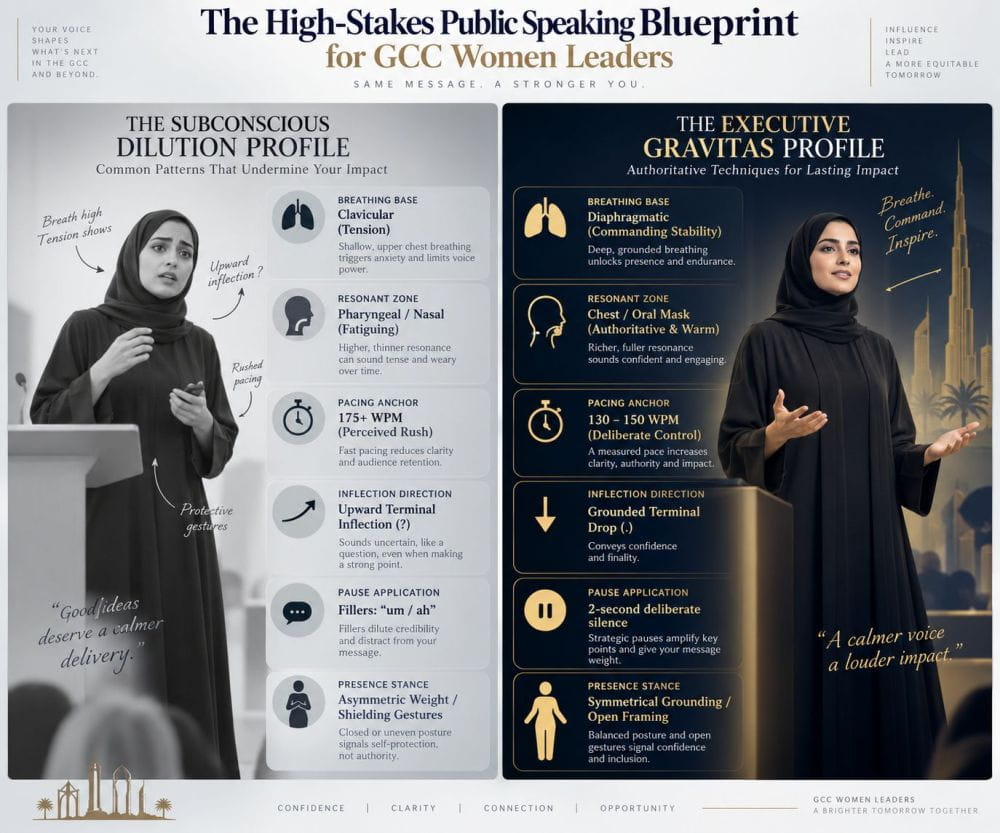
| Vocal Resonance Trumps Volume | Shifting from clavicular breathing to diaphragmatic support drops vocal pitch into an authoritative chest register, reducing vocal strain and eliminating executive vocal fatigue during extended addresses. |
| Strategic Pausing Replaces Filler Traps | Replacing apologetic fillers or fast pacing with intentional two-second silence signals cognitive control, commands room attention, and bypasses culturally ingrained modesty defaults. |
| Contextual Nonverbal Alignment | Calibrating formal Gulf boardroom decorum with decisive, open upper-body gestures establishes natural leadership gravitas across both local advisory boards and global panels. |
Why Vocal Presence Defines Executive Gravitas in the GCC
Vocal presence is the auditory dimension of executive stature. In high-stakes regional forums—such as the Dubai International Financial Centre (DIFC) summits or governmental panels—decision-makers form assessments of executive competence within seconds of an opening address.
Many accomplished female leaders encounter a recurring challenge: while their analytical capabilities are undisputed, their vocal projection does not reflect their seniority. This disconnect rarely stems from a lack of confidence. Instead, it results from physiological breath patterns, habitual pitch elevation under scrutiny, and the cultural nuances of corporate discourse across the Gulf.
Women executives in the Middle East balance distinct communication demands. Regional business settings prize relationship-driven diplomacy, indirect address, and deep institutional respect. Conversely, high-growth commercial landscapes demand brevity, clarity, and unambiguous authority. Projecting decisive vocal strength bridges these priorities, allowing you to honor professional courtesy without diluting your strategic position.
The Physiology of Authority: Breath, Pitch, and Resonance
Executive vocal authority originates in physiological mechanics. Under acute pressure, the sympathetic nervous system triggers shallow chest breathing, elevating the vocal tone and creating an impression of tension or urgency.
Shallow Clavicular Breath ──> Constricted Larynx ──> Elevated Pitch ──> Perceived Uncertainty

│

▼

Diaphragmatic Support     ──> Relaxed Vocal Cords ──> Deep Resonance ──> Executive Gravitas
Diaphragmatic Breath as a Foundation for Power
Sustained authority requires diaphragmatic breathing rather than shallow clavicular inhalation. When breath originates deep within the torso, vocal cords remain relaxed, allowing the voice to resonate within the chest cavity. This shift lowers the natural fundamental frequency, producing a richer acoustic tone that listeners perceive as grounded and dependable.
To build this support:
- Ground both feet evenly to stabilize the pelvis and spine.
- Inhale quietly through the nose, expanding the lower ribs horizontally rather than lifting the shoulders.
- Initiate vocal tone as an extension of the exhalation, keeping throat muscles unclenched.
Calibrating Pitch Range Under Pressure
A common mistake among executives addressing critical stakeholders is raising their vocal pitch at sentence boundaries, often called upward inflection or uptalk. This pattern reframes declarative recommendations as tentative inquiries.
Countering this habit requires practicing the “terminal drop”—allowing your vocal pitch to descend firmly at the end of strategic assertions. Ending statements on a downward pitch signals finality, institutional conviction, and strategic clarity.
For deeper insights into individual voice assessments, review our executive voice coaching methodology.
Navigating Cultural Nuance: Balancing Modesty and Decisive Command
In the UAE and the wider GCC, professional interactions reflect a high context culture. Communication honors hierarchy, courtesy, and relationship continuity. For female executives, this environment can lead to conversational hedging: softening direct recommendations with apologetic qualifiers (“I just wanted to suggest,” “If everyone agrees,” or “This might be one approach”).
While collaborative language serves an operational purpose during internal alignment, it dilutes your authority when addressing boards, sovereign wealth funds, or international partners.
Reframing Regional Cultural Strengths
| Outdated Delivery Habit | Strategic Executive Shift | Practical Boardroom Application |
| Softening directives with conditional buffers (“Perhaps we could look at…”) | Direct statement followed by evidence (“The strategic direction requires…”) | Prevents ambiguity during financial disclosures or capital allocation presentations. |
| Speaking rapidly to avoid appearing dominant | Deliberate cadence of 130–150 words per minute | Forces stakeholders to absorb complex financial models and corporate restructuring plans. |
| Over-smiling while delivering critical critiques | Neutral, focused facial expression with steady eye contact | Aligns facial affect with the gravity of regulatory updates or corporate restructuring. |
Authority in regional contexts does not demand aggressive posture. It demands clarity, deliberate pacing, and comfortable ownership of conversational space.
The Executive Vocal Presence Matrix
To systematically diagnose and refine your delivery, assess your current habits against the four pillars of the Executive Vocal Presence Matrix:
                 HIGH PROJECTION

                        │

      Authoritative     │      Commanding

      Academic          │      Executive

      (Needs Warmth)    │      (Target State)

                        │

LOW PACING ─────────────┼───────────── HIGH PACING

                        │

      Passive           │      Anxious

      Advisor           │      Deliverer

      (Needs Drive)     │      (Needs Grounding)

                        │

                 LOW PROJECTION
- Breath Architecture
- The Problem: High, shallow inhalations that dry out the throat and thin the vocal tone.
- The Correction: 360-degree lower-torso expansion before taking the stage or unmuting in executive briefings.
- Cadence and the Power of the 2-Second Pause
- The Problem: Rushing through critical operational transitions out of an impulse to yield the floor.
- The Correction: Inserting a clean, silent two-second pause before and after pivotal strategic declarations. Silence compels an audience to reset its focus and listen.
- Articulation and Plosive Clarity
- The Problem: Slurring consonants when delivering fast-moving quarterly metrics.
- The Correction: Crisp activation of dental and plosive consonants ($t$, $d$, $p$, $k$). Precise diction conveys intellectual precision and control.
- Acoustic Placement
- The Problem: Nasal or throat-centered resonance that tires the voice after 20 minutes.
- The Correction: Directing sound toward the “mask” (the hard palate and bridge of the nose) supported by chest resonance for a balanced, room-filling acoustic profile.
Structuring the Keynote: From Boardroom to Global Stage
Strategic delivery relies on clear structural scaffolding. A chaotic narrative structure undermines vocal polish. Senior corporate leaders benefit from using the Proposition-Impact-Resolution (PIR) Framework to anchor their presentations:
- Proposition (Direct Truth): Open with an unhedged macroeconomic, organizational, or industry assertion. Avoid rhetorical introductions or warm-up pleasantries.
- Impact (Evidence-Based Stakes): Outline the commercial or cultural costs of inaction, substantiated by verified figures.
- Resolution (Actionable Mandate): Present the strategic path forward, assigning specific responsibilities and clear next steps.
When paired with sustained eye contact and deliberate vocal pacing, this framework helps you steer the narrative rather than react to room dynamics.
To evaluate structured communication frameworks for your leadership cohort, explore our corporate public speaking workshops.
Frequently Asked Questions
How can women leaders project vocal authority without sounding aggressive in GCC boardrooms?
Authority stems from resonance and intentional pacing, not sheer volume or sharp inflection. In GCC boardrooms, an authoritative tone is calm, unhurried, and anchored in lower diaphragmatic breath. By replacing sharp assertions with steady, resonant delivery, a downward terminal pitch, and deliberate pauses, you communicate institutional stability and gravitas while honoring the relationship-first nature of regional leadership.
What is the most effective technique to stop using filler words during executive updates?
The most reliable technique is replacing the filler reflex with a clean breath through the nose. Fillers occur when the brain tries to hold conversational space while searching for a word. Train yourself to welcome silence. A two-second pause feels lengthy to the speaker, but to board members and peers, it reads as executive poise, thoughtful formulation, and command of the room.
How should female executives adapt their speaking style between local GCC meetings and international stages?
Local GCC settings benefit from elevated protocol: acknowledge regional leaders, emphasize collective organizational legacy, and maintain measured, diplomatic language. For international summits (such as COP or World Economic Forum panels), audiences look for immediate, problem-first statements, sharp data narratives, and energetic vocal projection. Retain your core vocal resonance across both, shifting primarily your cadence and narrative framing.
How can I stop my voice from shaking or pitching higher during high-stakes presentations?
Vocal shaking and rising pitch stem from adrenaline constricting the vocal folds and driving oxygen into the upper chest. To counter this mid-presentation, anchor your weight evenly on both feet, drop your shoulders away from your ears, and consciously extend your exhalations. Speaking at the bottom third of your natural breath prevents vocal fold strain and restores acoustic stability instantly.
Conclusion
Executive presence is neither an innate gift nor an unchangeable trait; it is an executive skill honed through deliberate practice and physiological calibration. As GCC economies accelerate their focus on diversification, innovation, and global leadership, female executives hold unmatched opportunities to influence business strategy. By mastering diaphragmatic resonance, deliberate pacing, and cultural adaptability, you ensure your vocal delivery matches your strategic vision.
To move beyond generic public speaking advice and systematically build boardroom command, partner with specialized guidance.
Elevate your executive delivery. Connect directly with Nooshin Panahi at nooshinpanahi.com to schedule an executive presence assessment and discover bespoke voice and speech programs designed for senior women leaders in the GCC.
AUTHOR INFORMATION & TRUST SECTION
Reviewed by Nooshin Panahi at Nooshin Panahi Coaching. This content reflects professional knowledge, current industry practices, and a strict commitment to accuracy in executive communications and vocal leadership across the GCC region.