
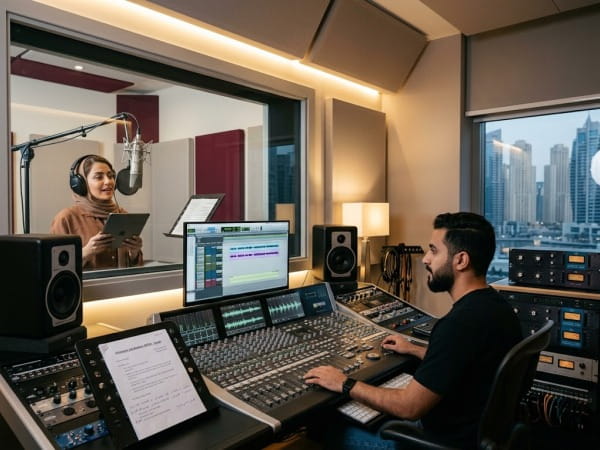
International brands expanding into the Middle East and North Africa (MENA) often make a costly assumption: thinking that converting an English script into Arabic or Persian word-for-word satisfies local audiences. When corporate presentations, product explainers, or brand films rely on literal translation, they routinely miss their commercial objectives. Viewers notice awkward cadence, misplaced metaphors, and disconnected emotional delivery.
Effective voiceover localization demands transcreation and cultural resonance. Across the Arab world and Iran, business communication relies heavily on relationship-building, respect, social context, and vocal presence.
The following guide examines why direct word replacement fails in corporate multimedia, how to navigate dialectal choices between Modern Standard Arabic (MSA), regional dialects, and Persian, and how to execute audio localization that earns lasting credibility.
Key Takeaways
| Core Insight | Practical Impact |
| Literal translation erodes brand authority | Word-for-word audio sounds mechanical, creates awkward time-sync issues, and alienates regional decision-makers. |
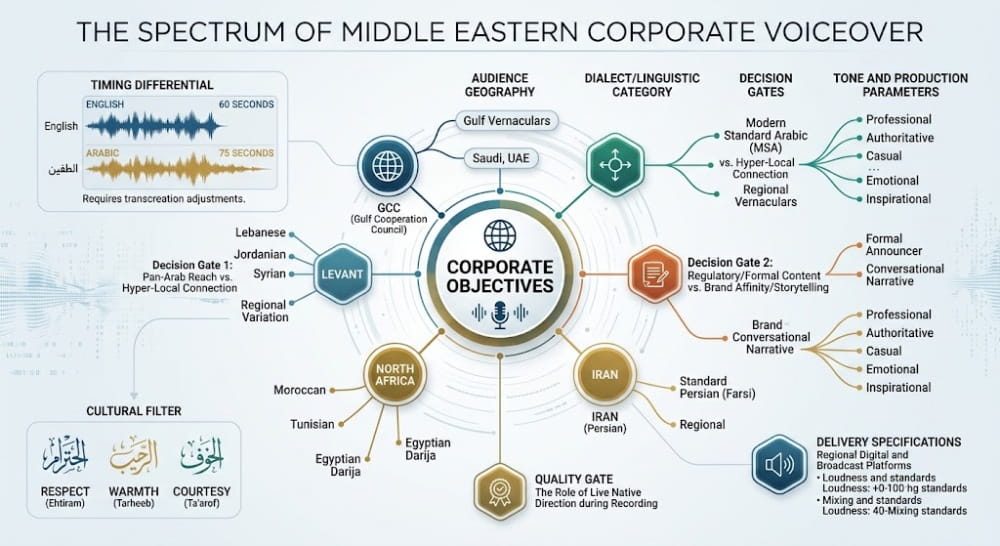
| Diglossia requires strategic dialect selection | Choosing between Modern Standard Arabic (MSA), Gulf Arabic (Khaleeji), Levantine, Egyptian, or Persian depends strictly on content type, audience seniority, and commercial objectives. |
| Non-verbal cadence carries cultural weight | Tone, pauses, warmth, and honorific forms reflect hospitality and deference, which matter as much as vocabulary in regional B2B settings. |
| Technical adaptation prevents desynchronization | Arabic text expands up to 25–30% relative to English, requiring audio script adaptation to preserve natural breathing and visual pacing. |
What Is Voiceover Localization in the MENA Context?
Voiceover localization is the practice of adapting recorded spoken audio to fit the linguistic, cultural, social, and technical expectations of a target market. It goes beyond standard translation by adjusting:
- Idiomatic expressions and metaphors
- Pacing, tone, and emotional delivery
- Pronunciation and dialect selection
- Timings to fit existing video timecodes
In the Middle East and North Africa, corporate communications operate within high-context cultures. Audiences do not evaluate spoken copy solely on technical precision; they evaluate the speaker’s warmth, confidence, deference, and cultural fluency.
When a Western corporate script uses terms like “move fast and break things” or “touching base,” a word-for-word translation creates confusion or strikes executive listeners as reckless and transactional. Culturally nuanced voiceover preserves the strategic intent while rewriting the phrasing so that it feels natively conceived in Arabic or Persian.
Why Literal Translation Fails in Corporate Audio
Corporate audio cannot be treated like software strings or legal agreements. A literal translation creates immediate friction in three areas:
[Literal Translation Process]
Source Script (English) ──> Word-for-Word Dictionary Match ──> Rigid Vocal Delivery (Alienates Audience)
[Culturally Localized Process]
Source Script (English) ──> Transcreation & Cultural Filtering ──> Regional Voice Actor (Builds Trust & Resonance)
- Semantic Distortion and Dead Idioms
Western corporate media frequently relies on sports analogies, nautical terms, and colloquial idioms (“touchdown,” “plain sailing,” “circle back”). Translating these directly into Persian or Arabic creates nonsensical phrases.
In Persian (Farsi), respectful business relationships require an understanding of social etiquette (Ta’arof), where direct, aggressive statements are tempered with elegance and hospitality. In Arabic, expressions of partnership, shared growth, and community benefit carry far greater credibility than hyper-individualistic claims of market domination.
- Linguistic Expansion and Desynchronization
Arabic and Persian translations typically require 20% to 30% more syllables than their original English counterparts to convey identical concepts. If a voice artist attempts a word-for-word reading over an existing video timeline, they must rush their delivery to match the on-screen graphics.
The result is frantic, clipped audio that strips corporate communications of poise, executive authority, and clarity. Native transcreation edits and condenses the copy during the script adaptation phase so the voice artist speaks at an authoritative, natural tempo.
- The Trust Deficit
Corporate media in the Gulf Cooperation Council (GCC) and broader MENA regions serves to establish trust between organizations. High-level executives and government stakeholders can immediately tell when audio has been mechanically generated or routed through non-native adapters. It communicates a lack of commitment to the region, undermining the brand’s perceived reliability.
Dialect Strategy: Choosing Modern Standard Arabic, Regional Vernaculars, or Persian
One of the most complex strategic decisions in MENA multimedia production is selecting the appropriate linguistic register. The Arabic-speaking world operates under diglossia, meaning Modern Standard Arabic (MSA or Fusha) coexists with distinct regional spoken dialects (Ammiya).
┌───────────────────────────────┐
│    Linguistic Strategy in     │
│         the MENA Region       │
└───────────────┬───────────────┘
                │
┌──────────────────────────────┼──────────────────────────────┐
▼                              ▼                              ▼
┌──────────────┐              ┌──────────────┐               ┌──────────────┐
│  Fusha (MSA) │              │ Gulf Dialect │               │ Persian      │
│              │              │  (Khaleeji)  │               │   (Farsi)    │
├──────────────┤              ├──────────────┤               ├──────────────┤
│ • Pan-Arab   │              │ • GCC Local  │               │ • Iran &     │
│ • Legal/Gov  │              │ • B2C Retail │               │   Diaspora   │
│ • Formal B2B │              │ • Emotional  │               │ • Formal vs  │
│   Explainers │              │   Storylines │               │   Colloquial │
└──────────────┘              └──────────────┘               └──────────────┘
Modern Standard Arabic (MSA / Fusha)
MSA is understood across all 22 Arab League nations. It serves as the standard for news broadcasting, formal legal documentation, academic discourse, and cross-border B2B software tutorials.
- Best used for: Corporate compliance videos, healthcare training, regional B2B software overviews, official government presentations, and banking reports.
- Limitation: Can sound overly formal, academic, or detached if used for casual brand films or lifestyle products.
Gulf Arabic (Khaleeji)
The GCC markets (UAE, Saudi Arabia, Qatar, Kuwait, Bahrain, Oman) represent high purchasing power and distinct cultural priorities. Using an authentic Khaleeji dialect signals direct investment in the local community.
- Best used for: Consumer campaigns, employer branding inside Saudi Arabia and the UAE, public service announcements, and high-impact brand storytelling targeting national citizens.
- Limitation: Less suitable for pan-Arab corporate materials shared across North Africa or the Levant.
Levantine and Egyptian Arabic
Egyptian is the most widely understood spoken dialect due to a century of regional cinema and music distribution. Levantine (Jordanian, Lebanese, Syrian, Palestinian) is widely appreciated for tech-forward, approachable, and creative consumer media.
- Best used for: Pan-regional consumer tech ads, customer service platforms, corporate podcasting, and conversational explainers.
The Persian (Farsi) Dimension
Often overlooked in generic “Middle East” localization briefs, Iran represents a market of over 85 million people with its own distinct linguistic rules. Persian is an Indo-European language, completely distinct from Arabic’s Semitic roots, though it utilizes the Perso-Arabic script.
- Corporate Persian requires a careful balance between the formal written register (Ketabi) and natural spoken cadence (Mohavereyi).
- Overly literal translations sound robotic. Successful production requires voice professionals who navigate Iranian cultural etiquette, current urban idioms, and proper formal address.
To streamline this decision, marketing teams can reference this regional matrix:
| Content Type | Primary Audience | Recommended Language/Dialect | Vocal Style Required |
| B2B SaaS Explainer | GCC & North Africa | Modern Standard Arabic (MSA) | Authoritative, measured, professional |
| National Day / Brand Film | UAE & Saudi Arabia | Khaleeji (Saudi/Emirati) | Warm, proud, inspiring, authentic |
| Internal Compliance & HR | Multinational Teams | MSA or Persian (market-dependent) | Clear, neutral, articulate, patient |
| Consumer FinTech App | Pan-MENA Retail | Egyptian or Levantine Arabic | Friendly, fast, engaging, trustworthy |
| Executive Leadership Video | Iran / Persian Diaspora | Formal Persian (Ketabi-Mohavereyi) | Respectful, articulate, executive presence |
Practical Execution: The Voiceover Adaptation Workflow
To protect audio productions from linguistic and cultural pitfalls, corporate marketing teams should follow a structured five-stage localization framework.
[Source Script Validation]
│
▼
[Transcreation & Adaptation] (Adjust word counts for 25% text expansion)
│
▼
[Cultural Sensitivity Review] (Audit idioms, values, honorifics, taboos)
│
▼
[Native Talent Casting & Direction] (Verify authentic accent, tone, pacing)
│
▼
[Time-Synced Post-Production] (Align audio cues to original video cuts)
- Source Script Audit: Remove Western-centric slang, metaphors, and wordplay from the source English script before sending it to translators.
- Transcreation (Not Translation): Commission a professional linguist specializing in multimedia adaptation to rewrite the message, keeping length, rhythm, and emotional intent in focus.
- Cultural Review: Screen the script for unintended cultural, religious, or political sensitivities. Adjust honorifics to match the seniority of the intended audience.
- Native Talent Casting: Audition voice artists based on their mastery of the target dialect, rather than relying on generalists claiming multi-dialect fluency. Check for regional accent authenticity and natural pacing.
- Timed Audio Mastering: Direct the studio recording against the video timecode to ensure natural pauses, visual synchronization, and proper sound design balance.
For more information on refining cross-border messaging, explore our guide to multilingual corporate media strategy.
Original Value Asset: The MENA Audio Localization Readiness Checklist
Before moving a localized script into the recording booth, evaluate your production against this professional checklist:
- [ ] Expansion Rate Checked: Has the script been read aloud against timecodes to ensure the ~25% text expansion of Arabic/Persian does not force unnatural speech?
- [ ] Register Match: Is the dialect choice (MSA vs. Khaleeji vs. Egyptian vs. Persian) aligned with whether the material is high-level B2B, legal compliance, or consumer marketing?
- [ ] Idiom Replacement: Have all sports, regional, and Western colloquialisms been replaced with regionally grounded metaphors?
- [ ] Honorifics and Politeness: Are the pronouns and direct addresses appropriate for the seniority level of the target business executive?
- [ ] Pronunciation Guide for Brand/Tech Terms: Has a phonetic guide been created for brand names, English acronyms, and product models so the voice artist uses consistent pronunciation?
- [ ] Studio Direction in Native Language: Will the recording session be monitored by a native speaker capable of catching subtle dialectal slips, incorrect vowel diacritics (Harakat), or awkward cadences?
Reviewing your projects with a specialized voiceover and communication partner helps eliminate costly re-records and guarantees cultural accuracy.
Frequently Asked Questions
Can I use Modern Standard Arabic (MSA) for every corporate video?
Modern Standard Arabic is universally understood across the MENA region and is the standard choice for technical explainers, legal notices, medical content, and formal enterprise presentations. However, using MSA for conversational brand films, personal testimonials, or emotionally driven recruitment videos can make your company feel detached. For customer-facing storytelling in markets like the UAE or Saudi Arabia, a localized Gulf dialect often produces significantly higher brand affinity and trust.
How does Persian (Farsi) localization differ from Arabic localization?
Persian is an Indo-European language with an entirely different grammar, syntax, and vocabulary history than Arabic, despite using a modified version of the same script. In corporate audio, Persian requires understanding of Ta’arof—a cultural framework of mutual deference and courtesy. Business scripts must balance formal elegance with modern conversational rhythm. Simply translating an Arabic script into Persian will sound jarring and culturally inaccurate.
Why does translated Arabic voiceover often sound rushed?
Arabic phrasing naturally takes 20% to 30% more syllables to convey the same concepts as English. When companies perform literal translations without adapting the script for time, the voice actor has to read at an unnatural speed to match the video graphics. High-quality localization incorporates transcreation to edit and condense the phrasing before recording, preserving an authoritative, natural speaking pace.
Is AI-generated synthetic voiceover ready for MENA corporate media?
While AI text-to-speech tools have improved, they struggle significantly with Arabic and Persian corporate audio. Arabic relies heavily on diacritics (Tashkeel) to convey grammatical case, meaning, and tone, which text-to-speech engines routinely mispronounce. Furthermore, synthetic voices lack the ability to express the nuanced warmth, deference, and emotional cadence central to business negotiations and trust-building across the MENA region.
Ensuring Long-Term Brand Credibility
Succeeding in the Middle East and North Africa requires more than linguistic conversion; it demands cultural alignment. When companies prioritize cultural nuance over literal translation, their media conveys respect, sophistication, and commitment.
To ensure your corporate media, explainers, and brand narratives communicate effectively across diverse regional markets, partner with experienced linguistic and vocal specialists. Working with proven voiceover, translation, and communication consultants like Nooshin Panahi ensures your corporate messaging achieves authentic resonance, builds trust, and delivers lasting results across the MENA region.
AUTHOR INFORMATION & TRUST SECTION
This guide was prepared using trusted industry sources and reviewed for accuracy, clarity, and usefulness.