

Leaving a meeting or a conversation with the frustrating realization that “that is not what I meant” is an experience shared across every industry. In modern workplaces, workplace communication breakdowns lead to missed deadlines, strained team dynamics, and stalled career progression.
When colleagues or managers misunderstand your intent, it is rarely due to a lack of effort on their part. More often, the issue lies in subtle gaps between your internal thoughts and your external delivery—specifically your vocal clarity, tone of voice, body language, and message structure.
Understanding why these disconnects occur and learning how to align your physical delivery with your intent allows you to take control of your professional interactions and ensure your ideas are received clearly.
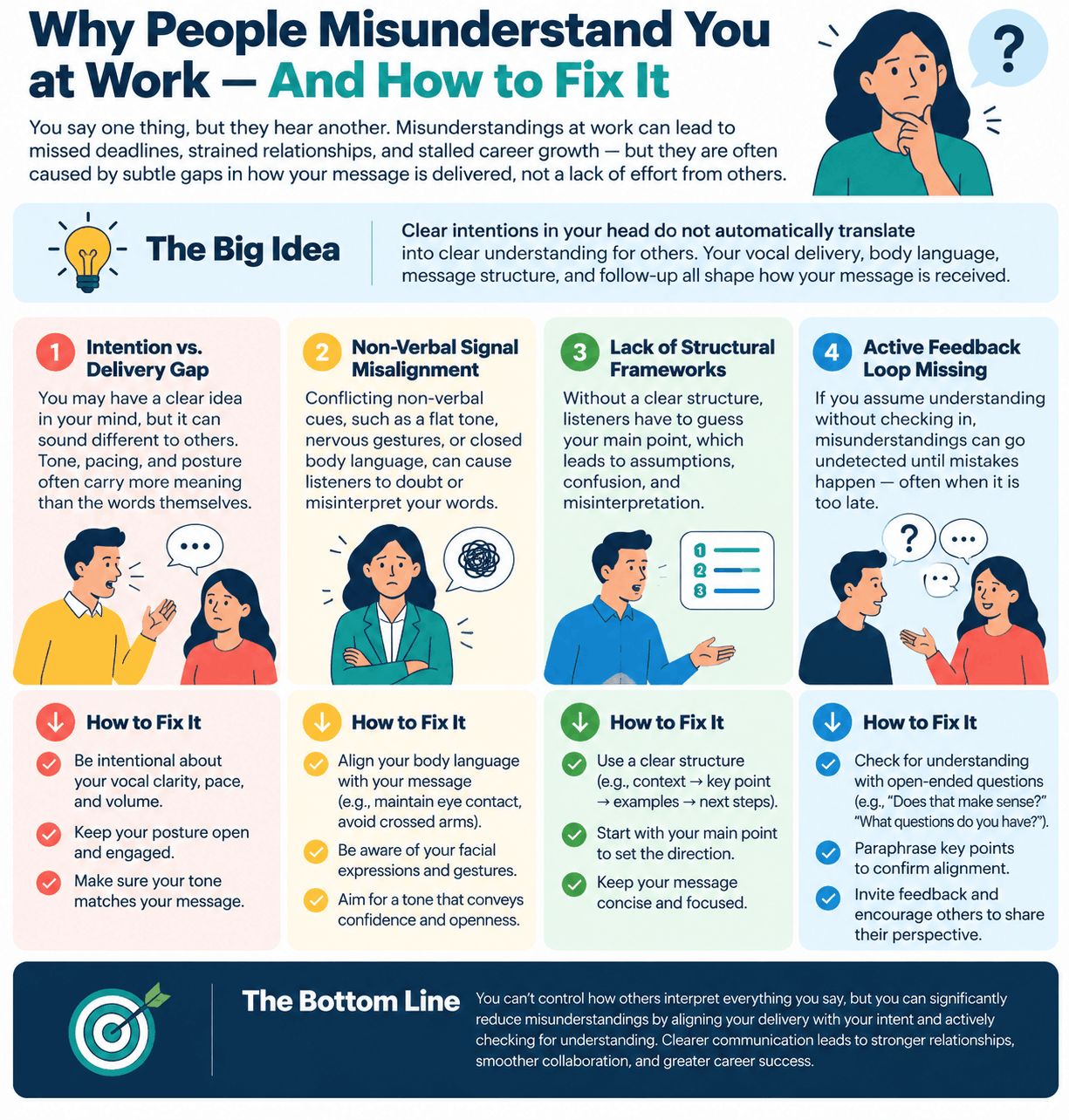
| Core Insight | Practical Impact |
| Intention vs. Delivery Gap | Expressing ideas clearly internally does not guarantee they sound clear to others; tone and posture carry the bulk of meaning. |
| Non-Verbal Signal Misalignment | Conflicting vocal inflection or closed body language causes listeners to doubt or misinterpret spoken words. |
| Lack of Structural Frameworks | Delivering information without clear framing forces listeners to guess your main point, leading to assumptions. |
| Active Feedback Loop Missing | Assuming understanding without checking in leaves misunderstandings undetected until mistakes happen. |
The Hidden Causes of Workplace Misunderstanding
Communication consists of three core components: verbal content (the words spoken), vocal tone (pitch, speed, and modulation), and non-verbal cues (body language, eye contact, and posture). When these three elements do not align, listeners experience cognitive dissonance and default to interpreting the delivery rather than the intent.
- The Disconnect Between Intent and Delivery
It is common to focus entirely on choosing the correct words while ignoring vocal tonality and facial expressions. You may present a critical project update with neutral intent, but if your vocal pitch remains flat or your stance appears guarded, team members might interpret the update as defensive, aggressive, or uncertain.
- Overestimating the Clarity of Your Message
Known in psychology as the “illusion of transparency,” individuals frequently assume that their background knowledge, context, and intent are obvious to others. In reality, colleagues lack access to your internal context. Without explicit framing, listeners filter your statements through their own assumptions and daily stressors.
- Incongruent Vocal Dynamics and Body Language
As highlighted in voice and communication coaching, a message becomes unclear when vocal tone and body language contradict spoken words. Slouching, avoiding eye contact, speaking too quickly, or failing to project your voice signals hesitation—even if the underlying content is thoroughly researched and completely accurate.
4 Frequent Workplace Scenarios and How to Correct Them
Scenario A: Your Feedback Sounds Like Criticism
- The Issue: Giving constructive notes on a project leads to defensiveness from a colleague.
- The Root Cause: Fast-paced delivery paired with downward vocal inflections makes suggestions sound like definitive judgments.
- The Fix: Pause before speaking, lower your tempo, and open your posture. Frame feedback around collaborative outcomes rather than individual actions.
Scenario B: Your Strategic Ideas Get Overlooked
- The Issue: Pitching a new initiative in a meeting results in little engagement or follow-through.
- The Fix: Lead with the core conclusion first (the “Bottom Line Up Front” approach). Avoid burying the key recommendation under excessive context or tentative phrasing like “I was just thinking maybe…”
Scenario C: Stakeholders Misinterpret Your Priorities
- The Issue: A status update creates panic among managers regarding project timelines.
- The Fix: Explicitly state risk levels alongside progress reports. Use precise language rather than ambiguous terms like “soon” or “nearly finished.”
Framework for Clear Communication
To prevent communication breakdowns before they occur, implement a systematic pre-conversation checklist to evaluate both structure and physical delivery:
[Define Core Message] ──> [Align Tone & Body Language] ──> [Deliver Headline First] ──> [Confirm Listener Understanding]
For a quick visual overview of how voice and body language impact message delivery, watch this practical breakdown:
Pre-Communication Quality Checklist
- [ ] Core Objective Defined: Can you summarize your primary point in one clear sentence?
- [ ] Vocal Projection: Is your voice originating from your diaphragm with steady breath support?
- [ ] Tone Alignment: Does your tone reflect the intended emotion (e.g., calm, authoritative, collaborative)?
- [ ] Physical Openness: Are your shoulders relaxed, uncrossed arms, and posture welcoming?
- [ ] Pacing & Pauses: Are you allowing deliberate pauses so the listener can process key data?
- [ ] Verification Step: Did you include a question at the end to check alignment?
How Voice and Non-Verbal Alignment Transform Professional Presence
Improving workplace communication requires expanding focus beyond written scripts or slide decks to include physical delivery. Voice modulation, breath control, and open body language directly influence how authoritative and accessible you appear to peers and leadership.
In her analysis on vocal impact and connection, communication consultant Nooshin Panahi highlights how subtle mismatches between posture, tone, and message content leave room for misinterpretation:
“Have you ever left a conversation thinking, ‘That’s not what I meant’? You think the other person misunderstood, but often the message itself was unclear. How was your body language? How was your tone of voice? To convey a message effectively, your verbal and non-verbal signals must work together so the listener truly gets your point.”
Developing awareness of these non-verbal signals prevents misunderstandings, builds rapport across teams, and ensures your contributions are recognized.
Core Delivery Metrics
| Delivery Component | Common Pitfall | Recommended Practice |
| Vocal Tone | Monotone or trailing off at sentence ends | Use varied pitch with confident, grounded sentence endings |
| Pacing | Speaking rapidly due to time pressure | Slow down slightly; use strategic 1–2 second pauses |
| Body Language | Crossed arms, fidgeting, or tense shoulders | Maintain relaxed posture, natural hand gestures, and steady contact |
| Message Clarity | Providing long background stories before the main point | State the primary recommendation first, followed by context |
Frequently Asked Questions
Why do colleagues interpret my straightforward comments as defensive?
Defensiveness is often communicated through vocal tone and posture rather than word choice. Quick responses, tight facial movements, or crossed arms signal guardedness. To prevent this, take a brief pause before responding, maintain an open posture, and speak with a calm, unhurried cadence.
How can I tell if my message was actually understood during a meeting?
Do not rely on passive nodding or simple agreement. Instead, use explicit confirmation techniques such as asking: “To make sure we’re aligned on the next steps, how does this fit into your team’s timeline for this week?” This prompts the listener to reflect back their understanding without feeling put on the spot.
What should I do immediately after realizing I was misunderstood?
Address the disconnect directly and calmly without placing blame. Use resetting phrases like: “Let me rephrase that—I didn’t communicate my point clearly.” Then, restate your primary message in one direct sentence, ensuring your tone remains balanced and constructive.
How does remote work make workplace misunderstandings worse?
Virtual calls limit non-verbal cues, making tone of voice and clear verbal structure far more critical. Additionally, written channels like Slack or email lack vocal inflection entirely, causing readers to project their own mood onto your text. For nuanced or sensitive topics, schedule a brief voice or video call rather than relying on text.
Conclusion
Miscommunication in the workplace is rarely an insurmountable barrier; it is simply a signal that delivery and intent are out of alignment. By focusing on non-verbal cues, maintaining steady vocal tone, and structuring messages clearly from the outset, you can ensure your ideas are understood as intended.
Mastering these skills requires intentional practice and professional guidance tailored to your specific communication style.
Master Your Workplace Voice and Presence
If you are ready to eliminate communication friction, elevate your executive presence, and express your ideas with clarity and confidence, professional coaching can accelerate your progress.
Explore tailored coaching programs, voice alignment sessions, and corporate communication strategies with Nooshin Panahi Voice & Connection to transform how you connect and communicate at work.
Author Information & Trust Section
Reviewed by Communication Specialist Team at Nooshin Panahi Voice & Connection. This guide reflects established principles in vocal mechanics, non-verbal communication, and professional interpersonal dynamics.