

Introduction
Many workplace communication problems are not caused by a lack of information. They happen because people hear words without truly understanding the message behind them.
A manager may hear an employee say, “I’m struggling with this project,” but a leader who listens will recognize concerns about workload, unclear expectations, motivation, or support. This difference between hearing vs. listening can influence trust, teamwork, employee engagement, and leadership effectiveness.
For companies operating in Dubai and the wider MENA region, where multicultural teams and international business relationships are common, strong communication skills are not optional. Leaders must understand different perspectives, cultural expectations, and unspoken concerns to make better decisions.
This guide explains the difference between hearing and listening, why active listening is a critical leadership skill, and how managers can develop communication habits that create stronger professional relationships.
Watch this short video about communication and listening skills
Key Takeaways
| Core Insight | Practical Impact |
| Hearing and listening are different communication processes | Leaders who understand the difference respond more effectively to employees and clients |
| Active listening builds trust and improves decision-making | Teams become more engaged when people feel understood |
| Great leaders listen beyond words | Understanding emotions, context, and cultural differences improves collaboration |
What Is the Difference Between Hearing and Listening?
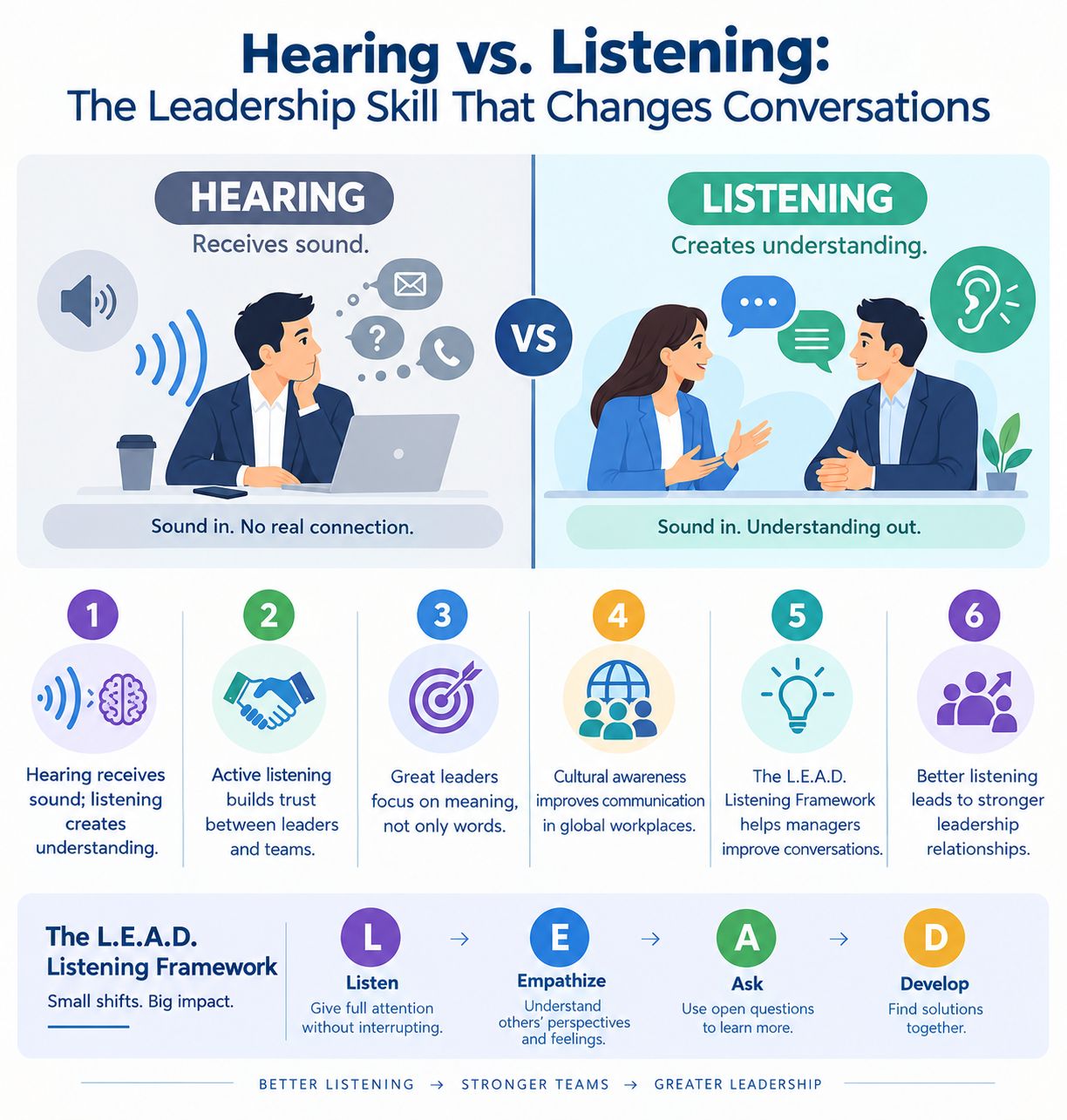
The main difference between hearing and listening is attention and intention.
Hearing is the physical ability to perceive sound. It happens automatically when sound waves reach the ears.
Listening is an active mental process that requires focus, interpretation, and response. It means making an effort to understand the speaker’s meaning, emotions, and purpose.
For example:
- A manager hears an employee say: “The deadline is difficult.”
- A leader listens and asks: “What part of the process is creating the biggest challenge?”
The first response acknowledges the words. The second explores the problem.
In professional environments, effective communication depends less on how much information is exchanged and more on how well that information is understood.
Why Listening Skills Matter for Modern Leaders
Strong listening skills are one of the foundations of successful leadership. According to communication experts, listening affects trust, conflict resolution, innovation, and employee relationships.
Professionals commonly see the same workplace challenge: leaders often focus on delivering messages but spend less time understanding responses.
A leader who listens effectively can:
- Identify problems earlier
- Reduce misunderstandings
- Improve employee confidence
- Build stronger client relationships
- Encourage honest feedback
- Make better strategic decisions
In multicultural business environments such as Dubai, listening also helps leaders recognize different communication styles and cultural perspectives.
Hearing vs. Listening: A Leadership Comparison
| Hearing | Listening |
| Passive process | Active process |
| Focuses on sounds and words | Focuses on meaning and context |
| Requires little effort | Requires attention and intention |
| Often produces quick reactions | Encourages thoughtful responses |
| May miss emotions or concerns | Recognizes both verbal and non-verbal messages |
A common mistake among managers is assuming that being present in a conversation means they are listening. Physical presence does not always equal mental engagement.
What Is Active Listening in Leadership?
Active listening is a communication technique where the listener intentionally focuses on understanding before responding.
A leader practicing active listening usually:
- Gives full attention
- Avoids interrupting
- Asks meaningful questions
- Clarifies unclear points
- Reflects on what was said
- Provides thoughtful responses
For example, instead of saying:
“Don’t worry, everything is fine.”
A listening-focused leader may say:
“I understand this situation is creating pressure. Can you explain what support would help you move forward?”
The second response creates space for discussion and problem-solving.
The Four Levels of Listening in Professional Communication
Understanding different levels of listening can help managers improve their communication approach.
1. Listening to Respond
This happens when someone is mainly preparing their own answer while another person is speaking.
Example: An employee explains a challenge, but the manager is already planning a solution without fully understanding the issue.
2. Listening to Understand
The listener focuses on the speaker’s message and asks questions to gain clarity.
This is the foundation of effective workplace communication.
3. Listening for Context
Experienced leaders look beyond the words.
They consider:
- Why is this person saying this?
- What concerns may not be directly expressed?
- What external factors influence this situation?
4. Listening for Connection
The highest level of listening builds trust.
The goal is not only solving a problem but creating a relationship where people feel respected and valued.

Why Good Managers Must Become Better Listeners
Management often involves planning, monitoring performance, and making decisions. However, leadership requires influence, trust, and understanding.
A manager who only communicates instructions may achieve short-term compliance.
A leader who listens creates commitment.
Example: Workplace Conflict Resolution
Imagine two team members disagree about responsibilities.
A manager who hears the complaint may immediately decide who is responsible.
A leader who listens may ask:
- “How did this misunderstanding happen?”
- “What expectations were unclear?”
- “What solution would help prevent this in the future?”
The second approach addresses the root cause instead of only treating the visible problem.
Common Listening Mistakes Leaders Should Avoid
1. Interrupting Too Quickly
Interruptions can unintentionally communicate that the speaker’s opinion is not important.
Better approach: Allow the person to complete their thought before responding.
2. Giving Solutions Before Understanding the Problem
Many leaders want to help quickly, but premature solutions can miss important details.
Better approach: Ask questions first.
3. Multitasking During Conversations
Checking emails or messages during discussions reduces attention and damages trust.
Better approach: Give important conversations your full focus.
4. Listening Only to Words
Communication includes tone, emotion, hesitation, and body language.
Better approach: Pay attention to the complete message.
A Practical Listening Framework for Managers
Use the L.E.A.D. Listening Framework:
| Step | Action |
| L — Look | Give visual attention and remove distractions |
| E — Explore | Ask questions to understand the situation |
| A — Acknowledge | Confirm that you understand the speaker’s perspective |
| D — Decide | Respond with appropriate action based on understanding |
This framework helps managers move from simple hearing to meaningful leadership communication.
How Companies in Dubai Can Improve Communication Culture
Organizations operating across Dubai and MENA often include diverse teams with different languages, backgrounds, and communication expectations.
Improving listening culture can involve:
- Leadership communication coaching
- Cross-cultural communication training
- Manager development programs
- Employee feedback systems
- Professional translation and interpretation support when needed
Effective communication is not only about speaking clearly. It is also about ensuring messages are understood accurately across different contexts.
For companies seeking professional support in consultation, translation, and communication services, Nooshin Panahi in Dubai provides communication-focused solutions designed to support business interactions and professional relationships.
Learn more at: https://nooshinpanahi.com
Expert Checklist: Are You Listening Like a Leader?
Use this checklist to evaluate your communication habits:
✅ I allow others to finish speaking before responding ✅ I ask questions before offering solutions ✅ I focus on understanding, not only answering ✅ I recognize emotions behind messages ✅ I avoid distractions during important conversations ✅ I confirm important information before making decisions ✅ I consider cultural differences in communication styles
If several items are missing, improving listening habits can significantly strengthen leadership effectiveness.
Frequently Asked Questions
What is the main difference between hearing and listening?
Hearing is the physical process of receiving sound, while listening requires active attention and understanding. Hearing happens naturally, but listening requires intention. In leadership, listening helps managers understand employee concerns, client expectations, and business challenges more accurately.
Why is active listening important for managers?
Active listening helps managers build trust, reduce misunderstandings, and improve decision-making. Employees are more likely to share ideas and concerns when they feel respected and understood. This creates stronger teamwork and supports a healthier workplace communication culture.
Can listening skills improve leadership performance?
Yes. Strong listening skills can improve relationships, conflict management, employee engagement, and collaboration. Leaders who understand different perspectives are often better prepared to respond effectively to complex workplace situations.
How can managers improve their listening skills?
Managers can improve by avoiding interruptions, asking open-ended questions, reducing distractions, summarizing key points, and seeking clarification before making decisions. Listening improves through consistent practice and awareness.
Why is listening especially important for companies in Dubai and MENA?
Dubai’s business environment includes professionals from many cultures and languages. Effective listening helps organizations reduce communication gaps, improve collaboration, and build stronger relationships with employees, partners, and clients.
Can professional coaching improve communication skills?
Communication coaching can help leaders identify ineffective habits and develop practical techniques for clearer conversations, better feedback, and stronger professional relationships.
Conclusion
The difference between hearing and listening is the difference between receiving information and understanding people.
Good managers communicate instructions. Great leaders create connections by listening carefully, asking better questions, and understanding the people behind the words.
For organizations in Dubai and the MENA region, improving communication skills can strengthen teamwork, client relationships, and leadership effectiveness.
For consultation, translation, and communication services, connect with Nooshin Panahi at https://nooshinpanahi.com.
Author Information & Trust Section
This guide was prepared using trusted communication and leadership principles and reviewed for accuracy, clarity, and usefulness.