
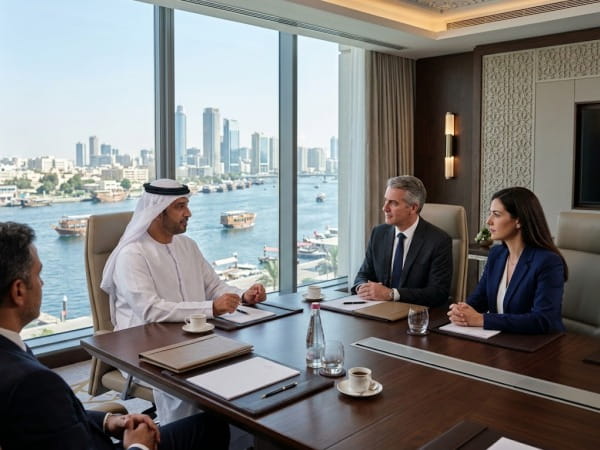
Executives entering a Gulf boardroom often discover that Western transactional playbooks fall flat in the United Arab Emirates. Direct challenges, rapid-fire point scoring, and rigid contractual posturing rarely produce closed deals in Abu Dhabi or Dubai. Instead, they often result in stalled talks, evasive follow-ups, and polite disengagement.
The underlying friction is not commercial; it is linguistic and cultural. High-stakes negotiations in the UAE operate within a high-context communication framework where linguistic nuance (what is left unsaid, how dissent is cushioned) and executive gravitas (emotional composure, respect for hierarchy, and relational integrity) carry far more weight than aggressive rhetoric.
Mastering boardroom negotiation in the UAE requires calibrating your vocal delivery, structuring indirect proposals, and reading the subtle verbal codes that separate real commitment from polite refusal.
Key Takeaways
| Core Insight | Practical Impact |
| Indirect Refusals Rule the Room | A literal “yes” or “Inshallah” often signals politeness or pending internal consensus rather than legal consent. |
| Gravitas Outranks Aggression | Raising voice pitch, rushing tempos, or public confrontation shatters executive poise and breaks foundational trust (thiqa). |
| Face-Saving Architecture is Non-Negotiable | Concessions must be framed around collective honor and partnership longevity, never personal capitulation. |
| High-Context Phrasing Drives Progress | Rephrasing categorical disagreements into conditional queries preserves momentum without forcing public conflict. |
Why Western Boardroom Rhetoric Stalls in the UAE
In low-context environments like North America or Northern Europe, communicators prioritize explicit, precise, and contract-first language. If an executive disagrees with a valuation or delivery schedule, standard protocol encourages direct counter-arguments.
In the UAE, communication is fundamentally high-context and relation-first. The verbal message cannot be separated from the status of the speaker, the presence of senior leadership, or the imperative to preserve wajh (face/social standing).
┌─────────────────────────────────────────────────────────────┐
│                 COMMUNICATION FRAMEWORK                     │
├──────────────────────────────┬──────────────────────────────┤
│    Low-Context (Western)     │     High-Context (UAE)       │
├──────────────────────────────┼──────────────────────────────┤
│ Explicit, literal words      │ Implicit subtext and silence │
│ Task precedes relationship   │ Relationship precedes terms  │
│ Open dissent is "honest"     │ Open dissent is hostile      │
│ Fast concessions as leverage │ Measured pacing builds trust │
└──────────────────────────────┴──────────────────────────────┘
When an executive uses combative language or forces a counterpart into a binary “take it or leave it” position during a formal meeting, the counterpart will almost never say “No” outright. Instead, the room will respond with polite affirmations, tea will be served, and future access will vanish.
Decoding Linguistic Nuance: The Subtle Lexicon of Gulf Negotiations
Navigating boardroom dialogue in the UAE requires listening to cadence, subtext, and conditional framing rather than relying on literal interpretation.
The Cultural Translation Matrix
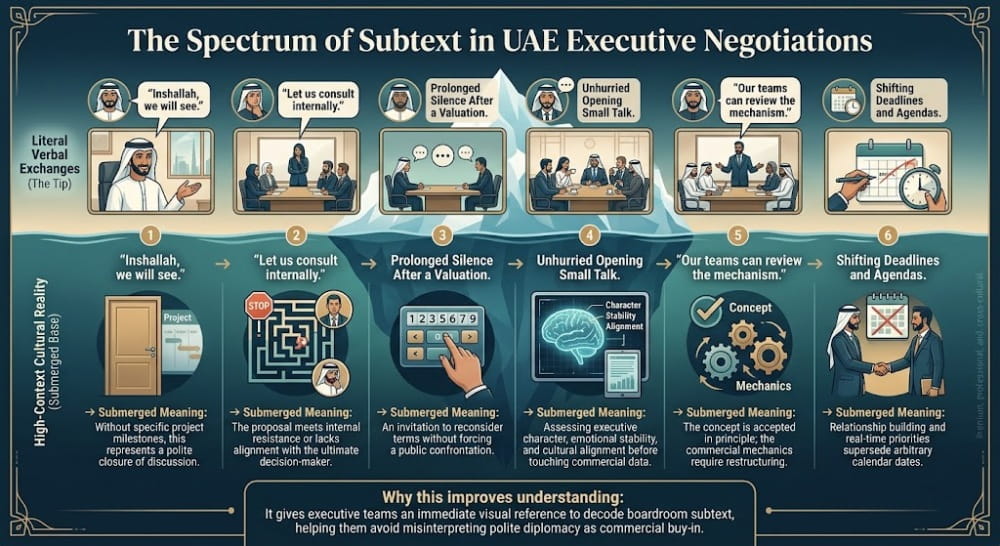
- “Inshallah” (If God wills): In everyday speech, it denotes faith. In business negotiation, context determines its meaning. Paired with intense focus and immediate next steps, it signals genuine optimism. Paired with diverted eye contact, brief hesitations, or vague delivery timelines, it functions as a polite deferral or soft decline.
- “We will study this matter thoroughly”: When delivered by a senior principal without establishing a follow-up milestone, this indicates commercial misalignment. Forcing an on-the-spot clarification causes embarrassment; the correct response is granting conversational space.
- “This is somewhat challenging for us at this stage”: This is not an opening gambit for an aggressive counter-offer. It is an indirect notification that the current parameter is unacceptable in its existing state.
For an in-depth breakdown of cross-cultural vocal dynamics, review our guide to the executive voice in cross-cultural leadership.
Executive Gravitas: Pitch, Cadence, and Strategic Silence
Gravitas is not loud; it is grounded. In senior Emirati and Gulf boardrooms, true authority rarely belongs to the most vocal participant in the room. Frequently, the most senior stakeholder sits quietly, observing how foreign representatives manage pressure, interruptions, and hierarchy.
┌─────────────────────────────────────────────────────────────────┐
│              THE 3-TIER GRAVITAS VOCAL BLUEPRINT                │
├──────────────┬─────────────────────────────┬────────────────────┤
│ Dimension    │ Destructive Pattern         │ Executive Standard │
├──────────────┼─────────────────────────────┼────────────────────┤
│ Pitch Range  │ Rising terminal inflections │ Grounded baritone/ │
│              │ (uptalk sounds uncertain)   │ resonant chest tone│
├──────────────┼─────────────────────────────┼────────────────────┤
│ Speech Rate  │ Rapid-fire delivery         │ Measured tempo with│
│              │ (suggests inner panic)      │ deliberate pauses  │
├──────────────┼─────────────────────────────┼────────────────────┤
│ Response Gap │ Immediate, defensive cuts   │ 2-3 seconds of calm│
│              │ into another's sentence     │ contemplative rest │
└──────────────┴─────────────────────────────┴────────────────────┘
Navigating Intentional Silence
Western executives often interpret boardroom silence as dead air that must be filled with more data or defensive qualifying statements. In the Gulf, silence is a marker of deliberation, respect, and seniority. Rushing to break silence signals anxiety and gives away negotiation leverage. Maintain an open, upright posture, breathe from the diaphragm, and let the silence settle before continuing.
The PREP-D Negotiation Reframing Model
To dispute a term or decline an unworkable clause without triggering defensive friction, deploy the PREP-D Framework (Praise, Relate, Explore, Propose, Defer).
[1. Praise]   ──► Acknowledge the counterpart's vision and status
│
[2. Relate]   ──► Reiterate the mutual, long-term commercial alliance
│
[3. Explore]  ──► Surface constraints via conditional, non-accusatory inquiry
│
[4. Propose]  ──► Present solutions that preserve the counterpart's face
│
[5. Defer]    ──► Allow the final synthesis to sit with their leadership
Real-World Scripting Comparison
- Direct / Confrontational (High Friction):
“Your proposed payment schedule of 90 days creates an unacceptable cash flow burden for our operations. We must insist on Net-30 or we cannot proceed with the integration.”
- PREP-D Applied (High Gravitas):
“We deeply value the scale of ambition your board brings to this infrastructure program [Praise]. Our shared objective is seamless, top-tier execution across all phases [Relate]. If we look at the raw material procurement lead times under a 90-day cycle, we risk supply delays during peak milestones [Explore]. To ensure your timeline remains protected, could we explore a phased mobilization tranche upon milestone validation? [Propose]. We welcome your team’s perspective on how to structure this to safeguard your milestones [Defer].”
The second approach raises the identical business constraint while completely eliminating relational tension. To develop agility in these settings, explore our framework on navigating high-stakes corporate conversations in Dubai.
Hierarchy, Side Conversations, and Protocol Etiquette
Multilingual negotiations across Dubai and Abu Dhabi often involve rapid shifts between English and Arabic, accompanied by informal huddles among local delegation members.
- Side Consultations Are Not Disrespectful: When counterparts confer in Arabic or briefly pause proceedings to speak with a senior advisor, they are working through consensus building. Maintain your composure; never show impatience or suspicion.
- Addressing the Anchor of Influence: Formal protocol dictates greeting the eldest or most senior executive first. During discussions, divide eye contact respectfully between the operational speakers and the senior decision-maker, even if the senior leader remains silent for long stretches.
- Protecting the Corridor Conversations: The most critical breakthroughs in UAE dealmaking rarely take place across the central boardroom table. They occur during coffee breaks, corridor walks, and informal dinners. Linguistic subtlety in these informal spaces sets the stage for formal sign-off.
Original Value Asset: The UAE Boardroom Linguistic Audit
Use this self-evaluation matrix before entering your next bilateral or multi-party negotiation in the UAE.
BOARDROOM LINGUISTIC AUDIT (UAE EXECUTIVE STANDARD)
[ ] Cadence Control
– Is speech tempo paced at a calm, deliberate rate (130-145 WPM)?
– Are pauses of 2-3 seconds observed before answering senior questions?
[ ] Tone & Vocal Resonance
– Are sentences landing on a downward inflection (authority) rather than upward (seeking approval)?
– Is vocal projection generated from the diaphragm rather than a tight, stressed throat?
[ ] Semantic Cushioning
– Have all absolute negations (“impossible”, “we won’t accept”, “you are mistaken”) been purged?
– Are objections converted into hypothetical, conditional frameworks (“What if we considered…”)?
[ ] Status & Protocol Alignment
– Have all proper titles (His Excellency, Dr., Sheikh, Chairman) been verified and noted?
– Are concessions framed as collaborative adjustments rather than tactical wins?
[ ] Post-Meeting Deferral
– Is the meeting documented with warm, diplomatic, and relational language rather than aggressive ultimatums?
Frequently Asked Questions
How do I know if an Emirati board is genuinely interested or just being polite?
In the UAE, respect and hospitality are foundational cultural norms, which means meetings rarely end in open rejection. Real interest is indicated by behavioral progression: invitations to follow-up meetings with senior stakeholders, introduction of technical teams to review details, and informal corridor engagement. If follow-up communications receive polite, non-committal replies without access to decision-makers, the proposal has encountered an indirect refusal.
Should I bring an Arabic interpreter if the counterpart speaks fluent English?
Most Gulf boardrooms conduct international business in English. However, having an experienced executive communication specialist or bilingual liaison on your side of the table can be invaluable. They catch cultural idioms, subtle shifts in tone during internal discussions, and underlying hesitations that international executives might miss.
What is the most common linguistic mistake Western negotiators make in Dubai?
The most damaging mistake is using aggressive, debate-style rhetoric to prove a point. Challenging a senior counterpart’s premise directly or exposing an error in front of their colleagues destroys wajh (face). Once professional dignity is compromised, no amount of financial logic will rescue the deal. Disagreements must always be framed conditionally and respectfully.
How do voice modulation and posture project gravitas during high-stakes pitches?
Gravitas stems from physiological control. High anxiety elevates voice pitch and accelerates speech, making a negotiator appear reactive. Anchoring the voice in a lower, resonant register, speaking at an unhurried tempo, and holding calm eye contact signals unshakable executive confidence. It reassures counterparts that you remain dependable under pressure.
Elevating Boardroom Presence for Regional Dealmaking
Negotiating in the Gulf is an art where commercial acumen and interpersonal nuance are inseparable. Success does not come from out-arguing your counterparts across the table. It comes from establishing enduring relational trust (thiqa), protecting personal standing, and projecting calm authority through every spoken phrase and measured silence.
Executives who calibrate their voice, speech cadence, and cross-cultural agility gain a decisive advantage in the UAE’s strategic sectors.
To refine your boardroom delivery, sharpen your vocal presence, and navigate high-stakes executive negotiations across the Middle East, explore strategic communication coaching and advisory services at NooshinPanahi.com.
This guide was prepared using trusted industry sources and reviewed for accuracy, clarity, and usefulness.