
Cross-border commerce, real estate investments, and corporate restructuring between Persian-speaking jurisdictions and the United Arab Emirates require meticulous administrative compliance. In Dubai, an informal or uncertified translation holds zero evidentiary weight before local regulators, judicial bodies, and licensing departments. Submitting documents that fail to align with the specific procedural mandates of the UAE Ministry of Justice (MOJ) or respective Free Zone authorities leads to immediate rejection, forfeited government filing fees, and critical transaction delays.
Navigating the dual legal landscape of the UAE—distinguishing between onshore Mainland requirements and autonomous Free Zone jurisdictions—requires a precise understanding of when a certified Farsi translation must be in Arabic, when English suffices, and the exact sequence of diplomatic attestations needed to establish enforceability.
Key Takeaways
| Core Insight | Practical Impact |
| Language Mandate Separation | Dubai Mainland entities (DED/DET, Dubai Courts, Land Department) mandate legal translations into Arabic stamped by an MOJ-licensed translator. Financial Free Zones (DIFC, ADGM) operate under common-law frameworks and accept English. |
| Attestation Precedes Translation | A certified translation cannot cure an unlegalized source document. Original Iranian or Afghan civil/commercial records must complete consular and UAE Ministry of Foreign Affairs (MOFA) attestation before MOJ certification. |
| Dual-Phase Certification Workflow | For English-language submissions derived from original Persian texts, standard UAE practice requires translation from Farsi to Arabic, coupled with Arabic to English sworn certifications to preserve complete legal chain-of-custody. |
The Regulatory Framework: What Qualifies as a Certified Translation in Dubai?
In the United Arab Emirates, the term “certified translation” carries a distinct statutory meaning governed by Federal Law. Not all professional language agencies possess the authority to issue legally binding translations.
UAE Ministry of Justice (MOJ) Accreditation
An official legal translation accepted by UAE federal and local government entities must be executed by a translator who has passed the rigorous examinations of the UAE Ministry of Justice and holds an active license.
A valid MOJ-certified translation must feature:
- The sworn translator’s official registration and license number.
- The formal MOJ endorsement stamp applied in bilingual form (Arabic and English/Farsi).
- The translator’s legal signature and a declaration certifying accurate conversion of the source content without omissions or interpolations.
- Exact preservation of visible endorsements, including revenue stamps, registry serial numbers, notarial seals, and consular endorsements present on the source text.
Certified Translation vs. Sworn Legal Translation
While international business often uses “certified translation” to describe any document accompanied by an agency’s certificate of accuracy, UAE administrative bodies make a rigid distinction:
- Company-Certified Translation: A translation issued on a translation bureau’s letterhead with an internal quality stamp. This format is accepted primarily by private schools, certain corporate human resource departments, or initial commercial screening teams, but it is not legally binding in court or before mainland ministries.
- Sworn Legal Translation (MOJ-Certified): Translators are sworn officers before the judiciary. This status confers legal accountability and ensures documents are recognized across all UAE ministries, immigration authorities, courts, and notaries public.
Mainland vs. Free Zone Requirements for Farsi Documents
A frequent operational pitfall for foreign businesses and expatriates is treating Dubai as a monolithic administrative environment. In reality, jurisdictional boundaries dictate the acceptable target language and certification hierarchy.
Jurisdictional Language Requirements
│
┌──────────────────────────┴──────────────────────────┐
▼                                                     ▼
Dubai Mainland (Onshore)                             Free Zone Jurisdictions
-
- Target Language: Arabic (Mandatory) • Common Law (DIFC, ADGM): English
-
- Authority: MOJ-Licensed Translator • Hybrid / Commercial (DMCC, DAFZ, JAFZA):
-
- Entities: Dubai Courts, DED/DET, DLD, GDRFA Dual Bilingual Submissions Accepted
Dubai Mainland (Onshore Entities)
Dubai Mainland operations are governed by UAE civil law, where Arabic is the sole official language. When submitting corporate or personal Farsi documents to the Department of Economy and Tourism (DET), the Dubai Land Department (DLD), the General Directorate of Residency and Foreigners Affairs (GDRFA), or Dubai Courts, the translation must be completed into Arabic by an MOJ-licensed legal translator.
If an entity submits an English translation of a Persian commercial lease or power of attorney to a Mainland court, the filing will be dismissed on procedural grounds until translated into Arabic by an authorized legal translator.
Dubai Free Zones (DMCC, DAFZ, JAFZA, and Beyond)
Most commercial free zones operate with English as their primary administrative language for company incorporation, shareholder resolutions, and board meeting minutes.
- Commercial Free Zones (e.g., DMCC, JAFZA): Typically accept English translations of foreign corporate registries, articles of association, and passport records. However, if a dispute escalates or requires notarization via the Dubai Courts Notary Public, Arabic translation becomes mandatory.
- Financial Free Zones (DIFC & ADGM): The Dubai International Financial Centre (DIFC) and Abu Dhabi Global Market (ADGM) are independent common-law jurisdictions with their own court systems operating entirely in English. In these jurisdictions, certified Farsi-to-English translations prepared by accredited legal translators are standard and fully admissible.
Critical Document Categories: Overcoming Common Translation Pitfalls
Legal systems in Iran and Afghanistan contain civil, Sharia-based, and commercial codifications that do not map directly onto UAE civil or common-law terminology. Translating these texts requires precise legal equivalents rather than literal linguistic conversions.
- Identity and Civil Status Documentation
- The Iranian Shenasnameh (Identity Booklet): The Shenasnameh is a cumulative lifetime document detailing lineage, marriages, divorces, children, and death records. A certified translation must meticulously capture every marginal notation, official amendment stamp, and registration bureau seal. Overlooking canceled entries or civil registrar notes is a primary reason visa and citizenship files face delays at the GDRFA.
- National Identity Cards & Birth Certificates: Transliteration of proper nouns must precisely match the individual’s international passport. Even a one-letter divergence between a translated birth certificate and a current passport will halt residency processing or inheritance proceedings.
- Commercial and Corporate Records
- Official Gazette Notices (Ruznameh Rasmi): In Iranian corporate law, major corporate actions (director changes, share capital increases, liquidations, power allocations) are validated through publication in the Official Gazette. Translations of these gazette notices into Arabic or English must accurately translate formal corporate terminology—such as distinguishing between a “Managing Director” (Modir-e Amel) and “Chairman of the Board” (Rais-e Heyat Modireh)—to ensure clear signatory authority for corporate banking setups in Dubai.
- Articles of Association & Memorandums of Association (MoA): When setting up branch offices or subsidiaries of Persian-headquartered firms, the operational scope defined in the source charter must be aligned with the standardized activity lists of the UAE DET or target Free Zone.
- Judicial Instruments and Powers of Attorney (POA)
- Specific Authority Allocations: In standard Persian Powers of Attorney (Vekalatnameh), explicit statutory clauses govern real estate disposal, banking operations, and litigation representation. General statements like “full authority to act” are frequently rejected by Dubai Land Department notaries and UAE local banks. Translators must faithfully translate each distinct procedural power granted (e.g., Hagh-e Enteghal-e Melk, Hagh-e Solh va Sazesh) so that local legal counsel can accurately evaluate the scope of representation.
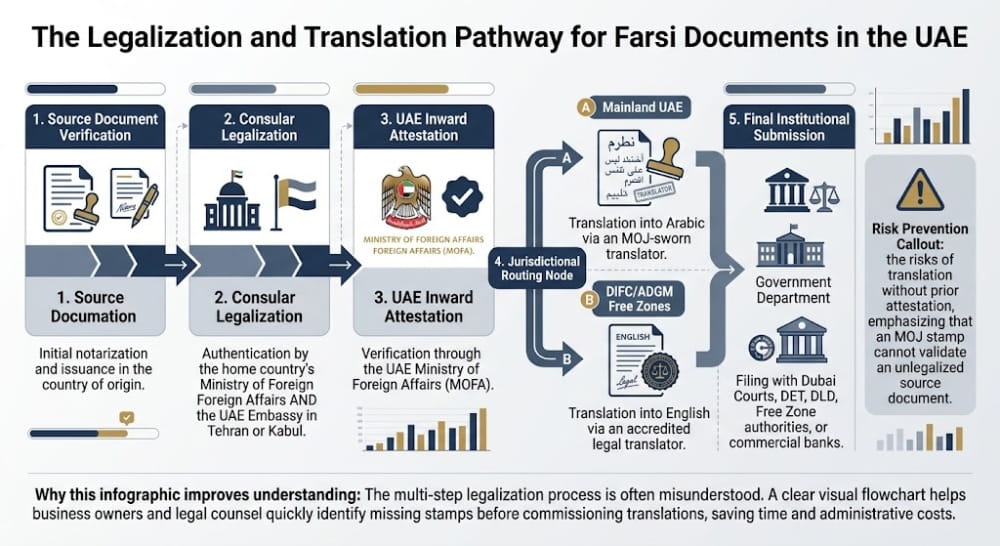
The Legalization and Attestation Pipeline
A legal translator in the UAE cannot authenticate a document whose fundamental chain of international custody is broken. Because Iran is not a signatory to the Hague Apostille Convention, documents originating in Iran cannot use a simplified apostille; they must complete the full diplomatic legalization chain.
Standard Attestation & Certification Pipeline
                                           │
  1. Origin Country Notary & Ministry of Foreign Affairs (MFA) Authentication
                                           │
                                           ▼
  2. UAE Embassy Legalization in the Country of Origin (Tehran / Kabul)
                                           │
                                           ▼
  3. UAE Ministry of Foreign Affairs (MOFA) Inward Attestation (Dubai / UAE)
                                           │
                                           ▼
  4. Sworn Farsi-to-Arabic / English Legal Translation by MOJ-Licensed Translator
                                           │
                                           ▼
  5. Ministry of Justice (MOJ) Attestation (Optional / When Specified by Courts)
- Origin Country Legalization: The original document must be verified by the issuing authority, certified by the national judiciary/notary, and endorsed by the origin country’s Ministry of Foreign Affairs.
- UAE Embassy Legalization: The document must be stamped by the UAE Embassy in the issuing country (e.g., the UAE Embassy in Tehran).
- UAE Ministry of Foreign Affairs (MOFA) Attestation: Upon arrival in the UAE, the document receives inward attestation via the physical or digital MOFA verification portal.
- MOJ-Certified Legal Translation: With foreign authenticity established, the sworn translator converts the complete document, including all stamps and endorsements, into Arabic or English.
- UAE Ministry of Justice Verification: If the translation is required for formal judicial proceedings, it undergoes final attestation by the MOJ.
Technical Translation Matrix: Navigating Institutional Standards
The table below outlines specific linguistic and formatting expectations across key Dubai institutions to help streamline administrative submissions:
| Institutional Authority | Primary Jurisdiction | Acceptable Language(s) | Certification Level Required | Common Failure Modes to Prevent |
| Dubai Courts (Civil, Commercial, Labor) | Mainland Dubai | Arabic Only | MOJ-Sworn Legal Translation | Submitting English-only translations; omitting handwritten judicial notes or registration dates. |
| Dubai Land Department (DLD) | Mainland Dubai | Arabic (Dual Arabic/English standard) | MOJ-Sworn Legal Translation | Inaccurate translation of property plot markers or incomplete Power of Attorney real estate clauses. |
| Department of Economy and Tourism (DET) | Mainland Dubai | Arabic / Dual Bilingual | MOJ-Sworn Legal Translation | Unaligned commercial scope descriptions; unverified shareholder registries. |
| DIFC Courts & Registrar of Companies | Financial Free Zone | English Only | Certified Legal Translation / Legal Accuracy Review | Submitting Arabic translations without an accompanying certified English text. |
| UAE Commercial Banks (Emirates NBD, FAB, Mashreq) | Federal / Emirates-wide | English or Arabic (Bank dependent) | MOJ-Certified or Verified Corporate Translation | Inconsistencies between translated beneficial ownership registers and active company trade licenses. |
Strategic Checklist: Preparing Farsi Documents for Submission in Dubai
To avoid institutional rejection and expedite processing, complete this verification checklist before commissioning your translation:
- [ ] Document Legibility: Ensure all marginal notes, serial numbers, stamps, and handwritten script in the original Farsi document are fully legible. Illegible text must be flagged as “indecipherable” by a certified translator, which may prompt rejections from regulatory reviewers.
- [ ] Complete Chain of Attestation: Verify that the source document carries physical or verifiable digital stamps from the origin country’s MFA, the UAE Embassy abroad, and the UAE MOFA.
- [ ] Target Audience Language Confirmation: Confirm whether the final receiving body is an onshore mainland entity (requiring Arabic) or a financial free zone authority (requiring English).
- [ ] Passport Name Alignment: Provide current passport copies for all individuals named in the documents to guarantee 100% spelling and transliteration consistency across all legal filings.
- [ ] Comprehensive Page Inclusion: Submit complete documents without omitted cover pages, annexes, or amendment sheets; missing attachments invalidate the parent document’s legal certification.
For complex commercial transactions or personal legal matters, pairing this administrative checklist with professional translation support helps maintain full compliance throughout your submission. Explore our guides on corporate document attestation processes and notarial services across Dubai free zones for deeper procedural insights.
Frequently Asked Questions
Can I submit an English legal translation of a Farsi document to Dubai Courts?
No. Dubai Mainland Courts operate strictly in Arabic. Any evidentiary filing, contract, commercial agreement, or foreign judgment submitted to Dubai Courts must be translated into Arabic by an MOJ-licensed legal translator. Submitting an English-only translation will result in procedural dismissal until a certified Arabic translation is provided.
Why does translating a Farsi document to English sometimes involve an Arabic intermediary step?
Under UAE Ministry of Justice regulations, official legal translators are licensed in specific, approved language pairs (typically Source-to-Arabic or Arabic-to-Target). Because Arabic is the federal legal language, official workflows frequently translate Farsi into Arabic through a licensed translator, and then from Arabic into English. Both certified translations are stamped, bound together, and submitted as an integrated legal translation packet.
Does a certified Farsi translation remove the need for UAE MOFA attestation?
No. A certified translation verifies only that the linguistic transfer from the source document is accurate and complete; it does not authenticate the original document’s underlying validity. UAE authorities require foreign documents to complete the full chain of consular and MOFA attestations before an MOJ-licensed translation can be accepted for official use.
How are handwritten Iranian civil status documents (such as older Shenasnameh records) handled?
Handwritten identity registries require specialized review by translators skilled in older Persian administrative handwriting (Shekasteh-ye Nasta’liq) and regional terminology. If sections are faded or illegible, the translator must legally transcribe them as “indecipherable” under MOJ standards. To avoid delays, individuals should secure an updated civil registry extract from the issuing authority before submitting their documents for translation.
Are certified translations completed in Iran or other foreign countries accepted by Dubai authorities?
Generally, no. Official bodies in Dubai, including the DED, DLD, and Dubai Courts, require translations prepared and stamped by an MOJ-licensed legal translator residing in the UAE. Translations completed abroad often lack the required local credentials, necessitating re-translation by a licensed UAE provider upon arrival.
Securing Accurate, Compliant Translations in Dubai
Maintaining business agility and personal legal standing in Dubai requires precision at every step of the administrative process. When translating complex Farsi legal agreements, corporate charters, or civil certificates, choosing an accredited linguistic partner is essential to ensure first-time acceptance across UAE Mainland authorities and Free Zone registries.
For dependable, compliant translation services, work with certified professionals who understand local regulatory standards. Visit NooshinPanahi.com to access certified Farsi, Arabic, and English translation services tailored to UAE Mainland and Free Zone compliance requirements.
This guide was prepared using trusted industry sources, regulatory frameworks, and recognized administrative standards, and reviewed for accuracy, clarity, and practical usefulness.